Key Takeaways
$100+ oil and $4.18 gasoline kill the easy-cut narrative.
Hot PCE keeps the Fed boxed; cuts are no longer the base case.
AI keeps carrying equities; NVDA can keep making new highs while OpenAI revenue questions hit the front page.
BTC needs $78k-$80k back; below $72k-$73k, the dip bid is gone.
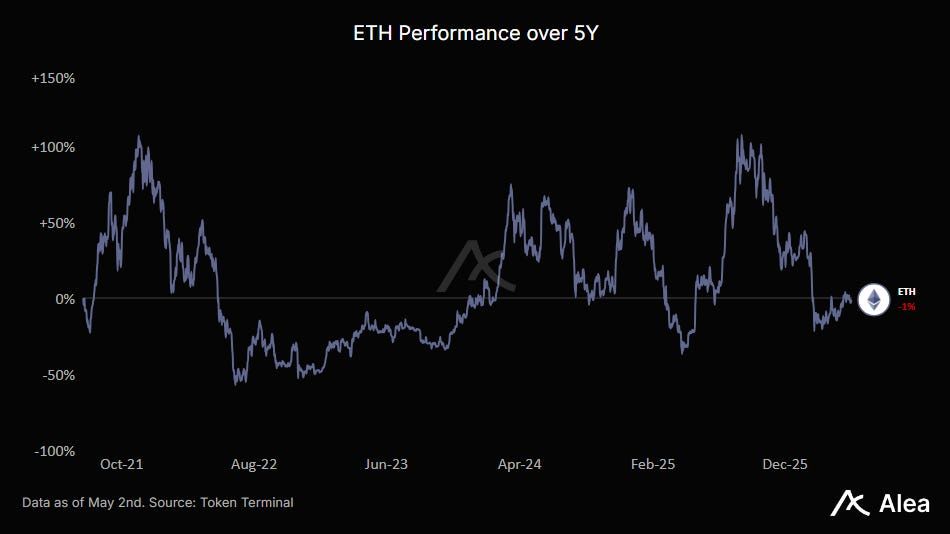
ETH at 2021 levels is not “cheap”; it is five years of weak marginal buyers.
PUMP’s ~$370M burn buys trust, but also burns optionality.
MORPHO has scale and institutional optics, but no holder revenue yet.
AAVE remains systemic, but pausing buybacks removes the mechanical bid.
Macro: Inflation Has a Fuel Problem
After the third attempt on Trump’s life, the U.S.-Iran peace hopes faded after the President cancelled envoys’ Islamabad trip. Separately, Macron pushed for reopening the Strait of Hormuz after TotalEnergies warned that prolonged disruption could create severe energy shortages, especially in Asia. Roughly 20% of global oil and gas shipments transit Hormuz. U.S. gasoline at $4.18 is a consumer-tax headline that is already undermining households and re-prices the Fed’s room to cut.

Oil >$100 while equities hold up. That begs the question: why are stocks still near highs while WTI is back above $100 and the Iran war keeps energy risk high. The answer is concentration. AI-linked mega-caps are carrying the market while fuel inflation hits consumers. This is an environment that can ignore oil for a few sessions when the index is this top-heavy, although that’s unlikely to be the case once margins, household spending, and Fed optionality start moving against it.

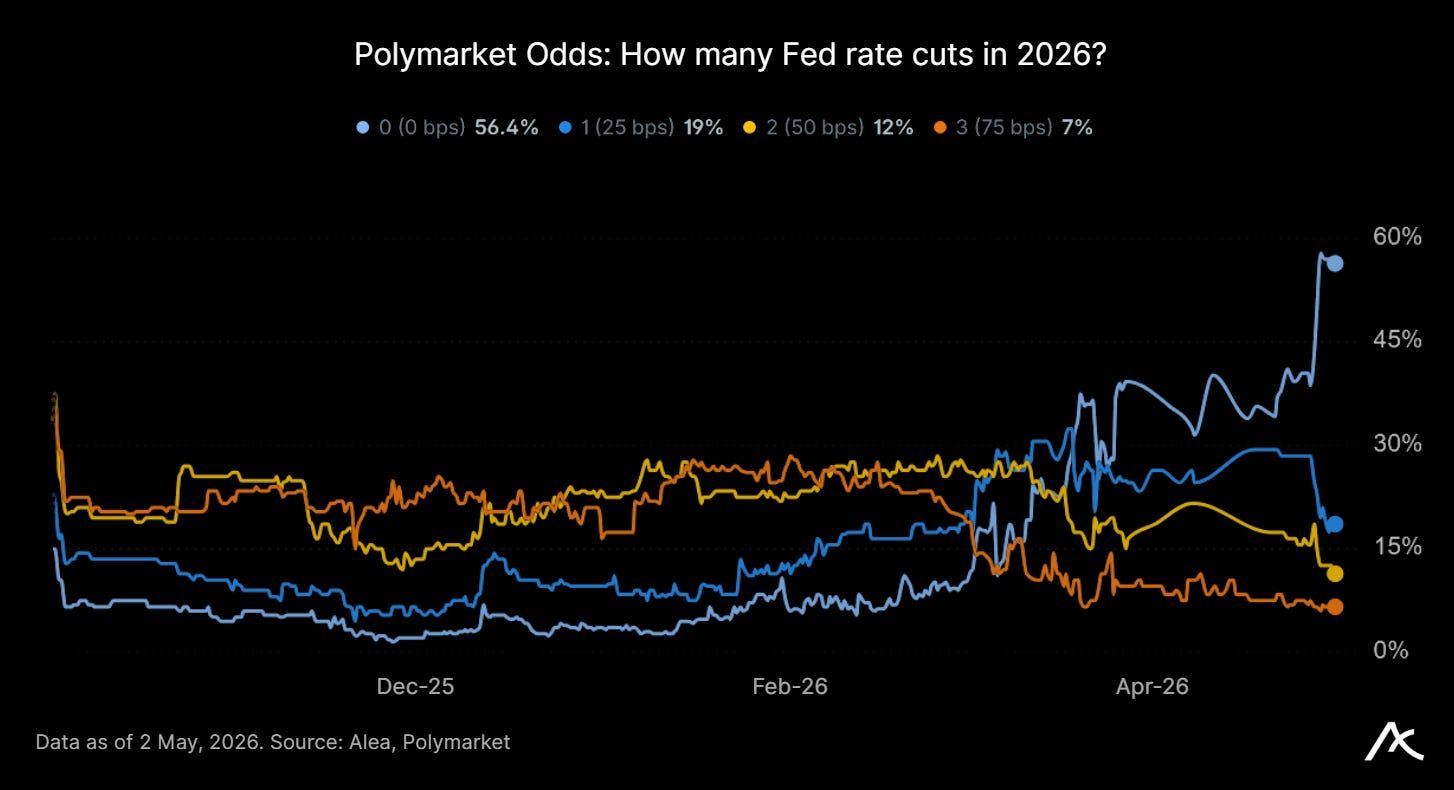
The Fed decided to stay on hold after this week’s FOMC, keeping rates at 3.50%–3.75% for the third straight meeting. Prices are still “elevated,” and the Middle East conflict adds uncertainty. Cuts are no longer the base case. Even a small hike risk is something to consider.
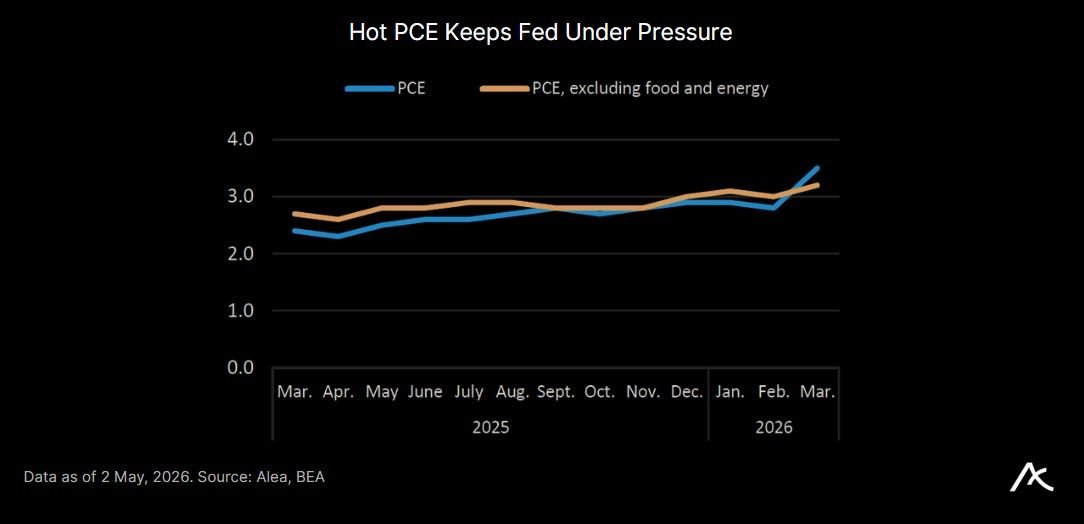
March PCE accelerated to +0.7% m/m and +3.5% y/y, with core still at +3.2% y/y; real spending rose only +0.2% while real disposable income slipped -0.1%. That is not demand collapse while Q1 GDP at +2.0% annualized keeps recession optics away, although the GDP PCE price index at +4.5% and core PCE at +4.3% annualized make the Fed’s job harder.
Crypto: Moats, Margins, Burns
Last week’s stress left onchain allocators wondering if DeFi yields are actually worth the risk they carry. It also left builders and researchers asking questions about what the “fair” rate of return should be onchain, and whether there is anything to be done to remain competitive against TradFi’s risk-free rate.
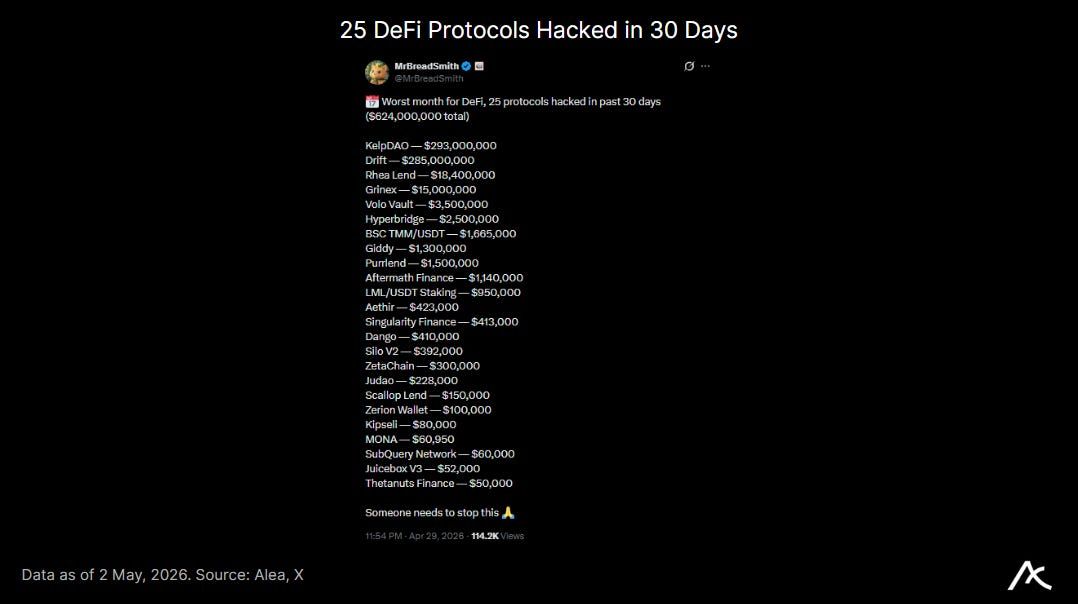
In crypto, lending rates alone account for a base rate + technical risk + liquidity risk + governance tail risks + loss-recovery uncertainty. That’s what today’s dark reality reflects, with many blue-chip DeFi yield sources sitting below what capital can earn in money-market funds, while asking users to absorb smart-contract risk, oracle risk, bridge risk, liquidation risk, and governance risk.
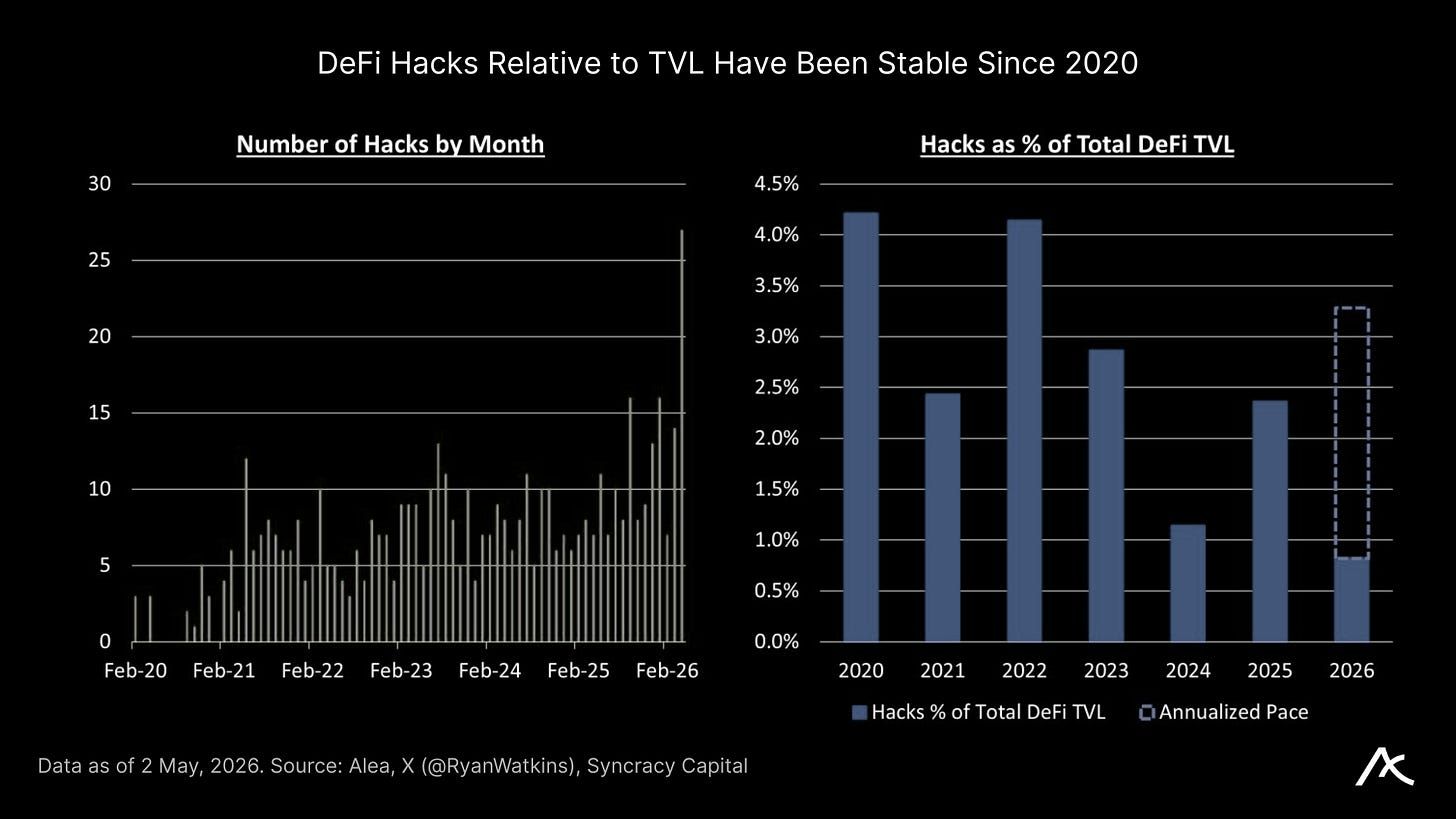
At the current annualized pace, 2026 is on track to reach a multi-year high in hack losses as a percentage of DeFi TVL, while also setting a new monthly high for the number of hacks in April-26.
Most desks are circling the same issue: can crypto still pull in capital when the flywheel belongs to a handful of protocols with scale and distribution? That creates a new problem: what should winners do with cash? What does value accrual look like for successful protocols like Morpho that haven’t activated the fee switch yet?
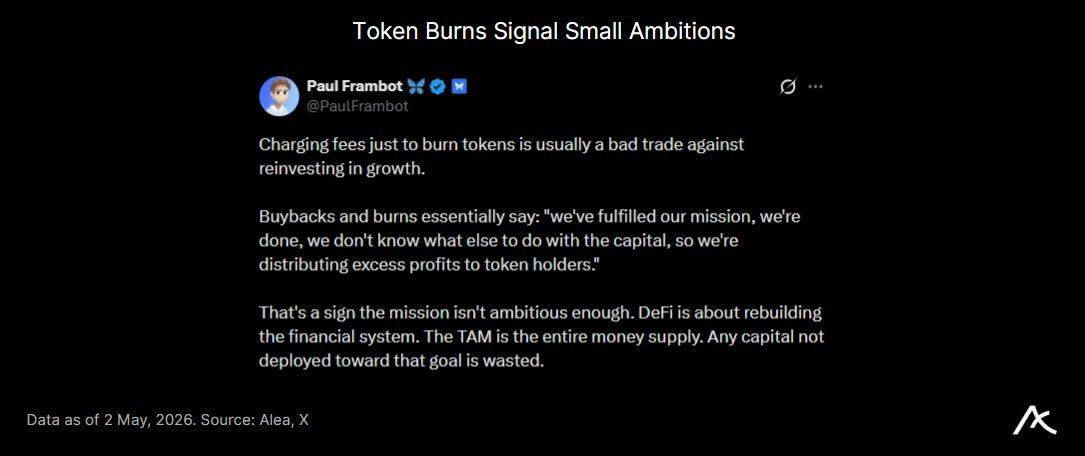
It’s become apparent that, to some extent, the market has been treating “value accrual” as a magic spell. In reality, a buyback is only as good as the business that funds it and the opportunity cost it gives up. Mature protocols can return more cash, whereas protocols in early growth stages would be better off aiming for user acquisition, integrations, and resilience to ensure longevity.
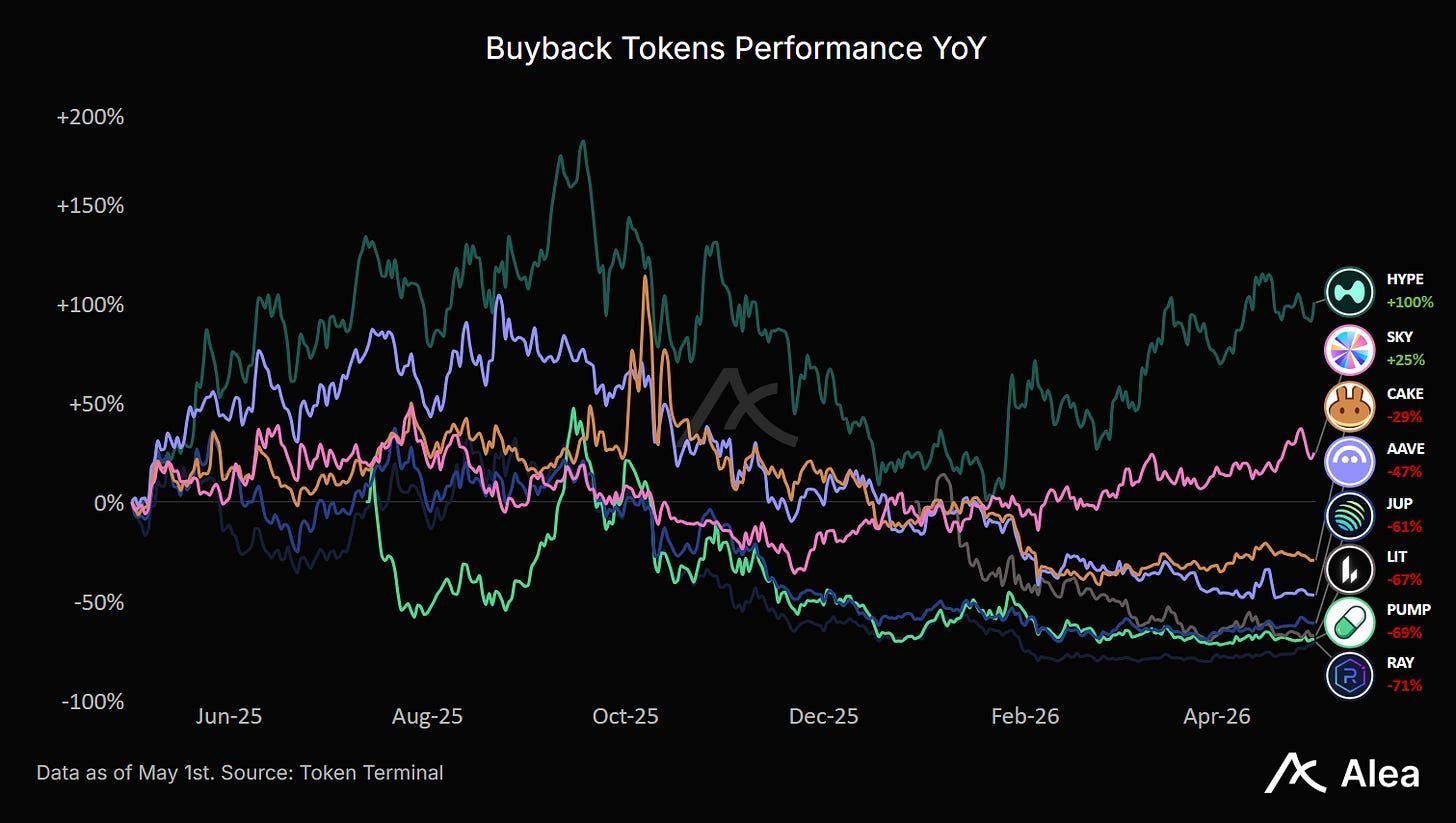
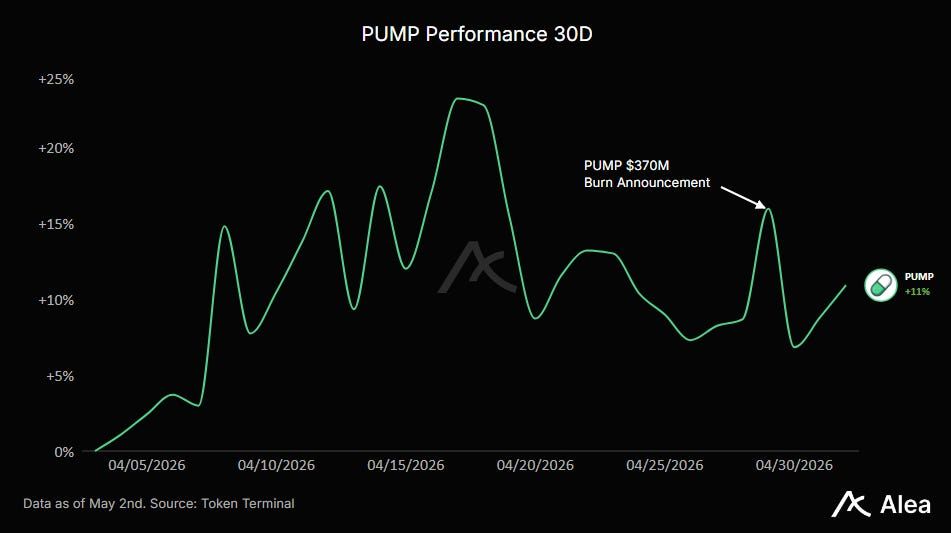
This week Pump.fun burned all previously bought-back PUMP: ~$370M of purchases, ~36% of circulating supply. Pump spent cash to buy PUMP, then burned the asset instead of holding it as treasury inventory. Economically, the burn removes ambiguity, i.e. no future sell-overhang. The real question is opportunity cost. Buybacks do not save weak businesses. If anything, they expose them. Only durable revenue with disciplined capital return is the closest thing crypto has to a real equity story.
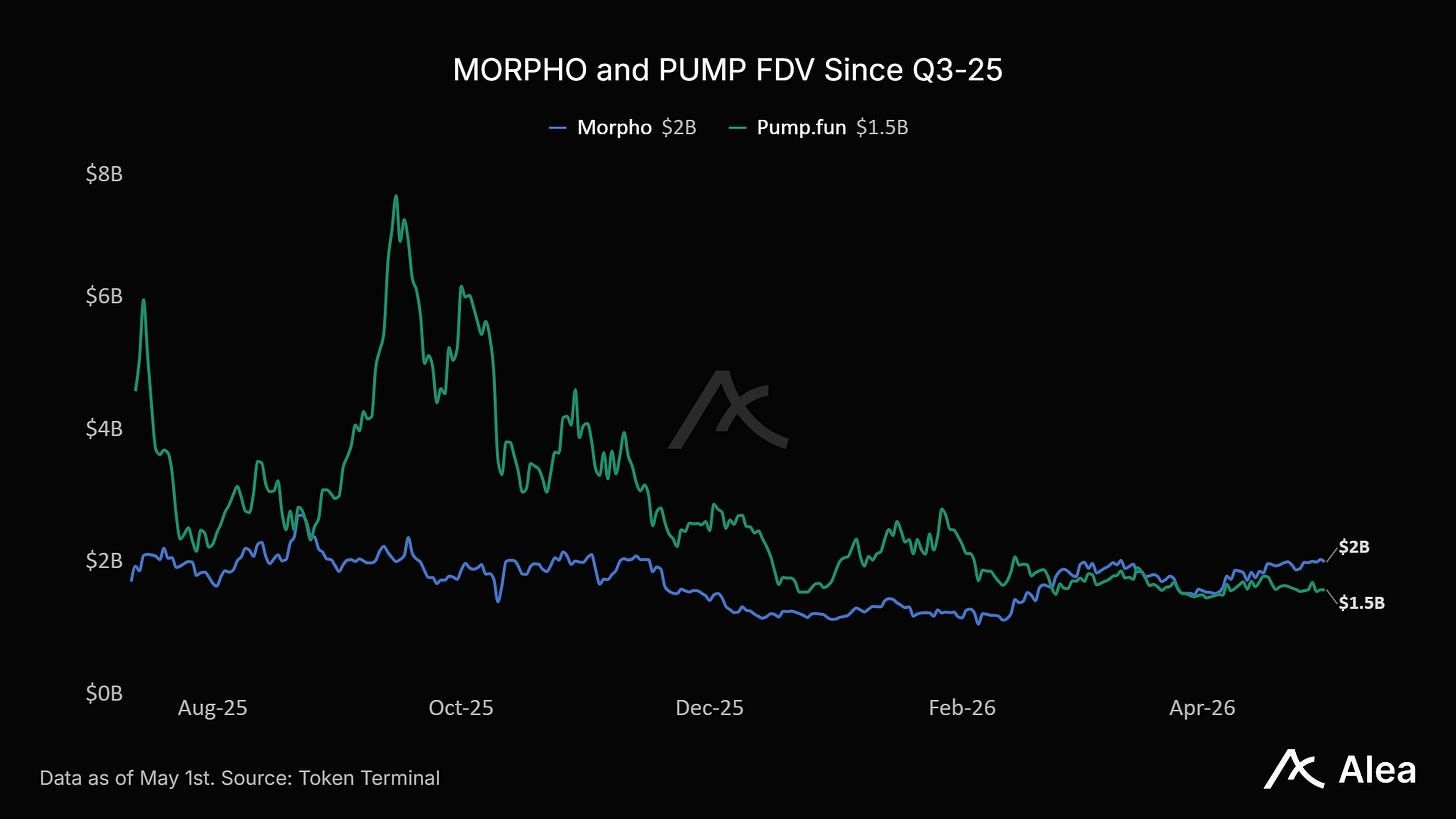
Burning tokens creates no users, no distribution, no product moat, and no new category by itself. In practice, a burn only matters if the business underneath can keep funding the burn. This is where the Morpho comparison is useful. Morpho has the institutional story, better “real finance” optics, and meaningful lending scale, but still $0 holder revenue despite ~$3.85B active loans. For Morpho, keeping the fee switch off can be rational if the priority is integrations, rate competitiveness, and institutional trust. For Pump, no buyback would be a red flag at this point.
Pump is not necessarily destroying capital, but it’s killing optionality. Burning bought-back tokens means those tokens can no longer be reused for incentives, acquisitions, treasury management, or market-making. That is a cost. In return, Pump bought trust. Now the market has to show reciprocity. That is the model mature protocols should study. It’s not black or white: “burn everything” or “never return cash.” The right answer is stage-dependent capital allocation: early protocols should buy users, integrations, resilience, and distribution; mature cash machines should return capital when marginal reinvestment no longer beats shrinking the float.
AI: The Compute Bill Comes Due
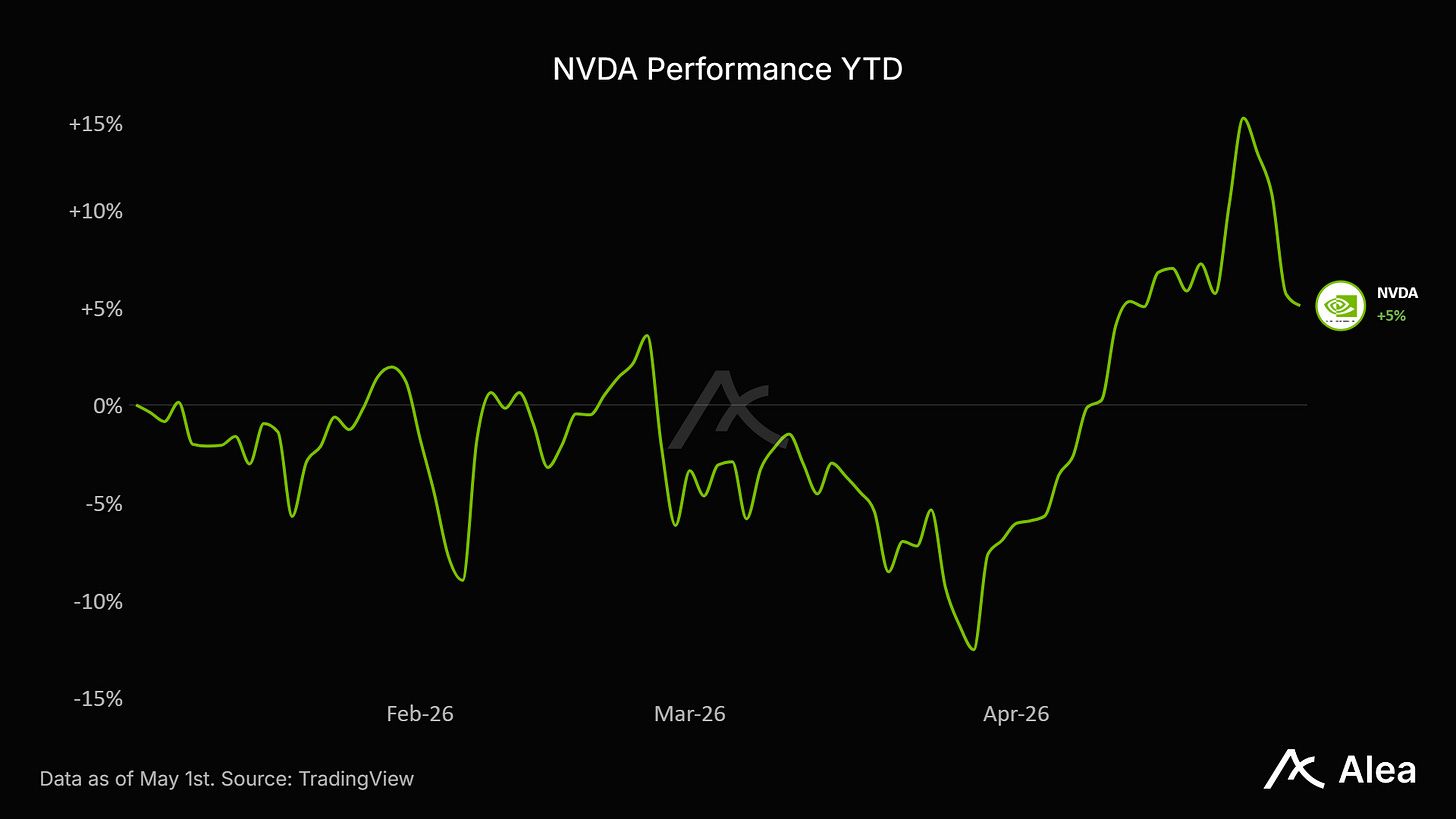
Nvidia made all-time-highs past ~$5.26T in market cap while the Wall Street Journal decided to stir the waters with a report claiming OpenAI missed internal revenue and user-growth targets, including the goal of reaching 1B weekly ChatGPT users. OpenAI pushed back hard, with Sam Altman and its CFO saying they are “totally aligned” on buying as much compute as possible.
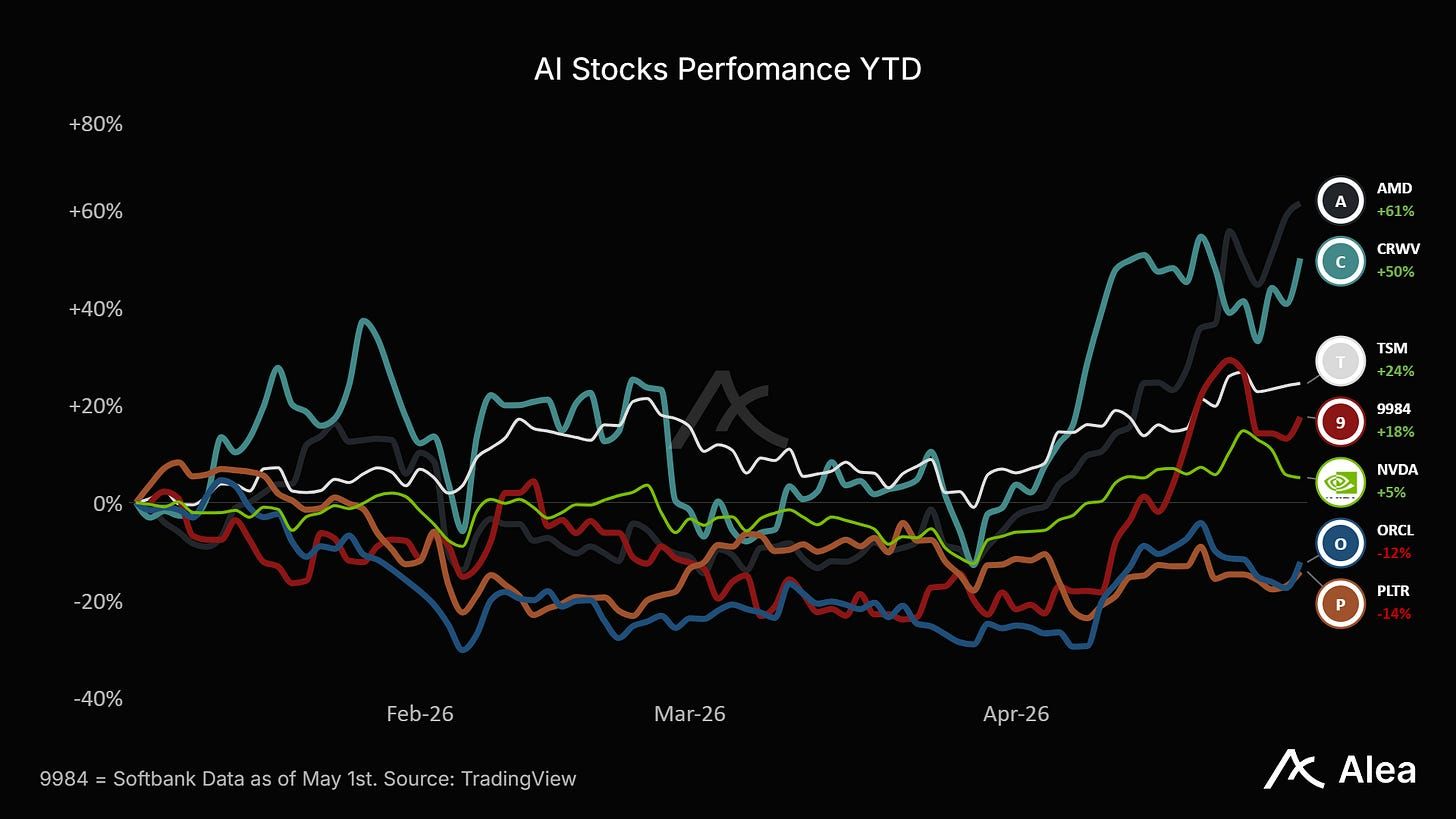
OpenAI’s playbook is well-known among proponents of the AI bubble: raise capital, buy GPUs, lease capacity, scale users, repeat. The WSJ went straight into the root problem: can paid conversion and enterprise revenue compound fast enough to finance the compute and investment already committed?
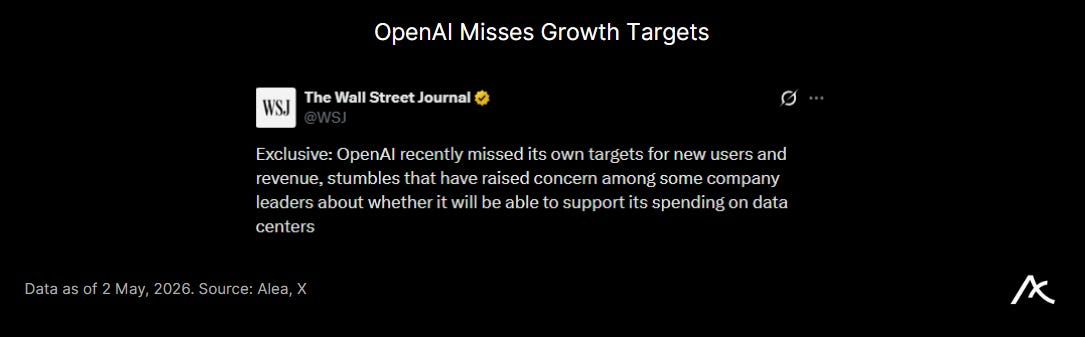
OpenAI’s own numbers and Codex’s most recent traction still argue the product is not weak. In February, the company said ChatGPT had more than 900M weekly active users, more than 50M consumer subscribers, and more than 9M paying business users; it also announced $110B in new investment at a $730B pre-money valuation, including $30B from Nvidia and $50B from Amazon.
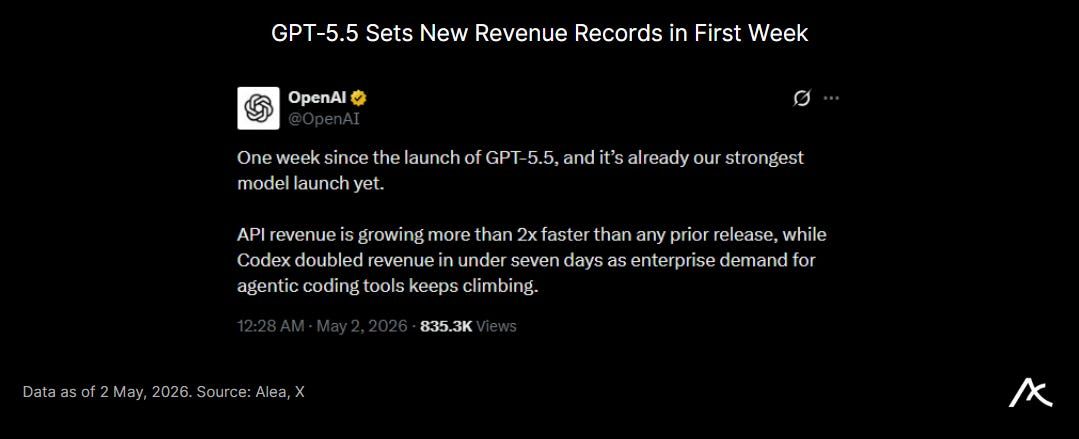
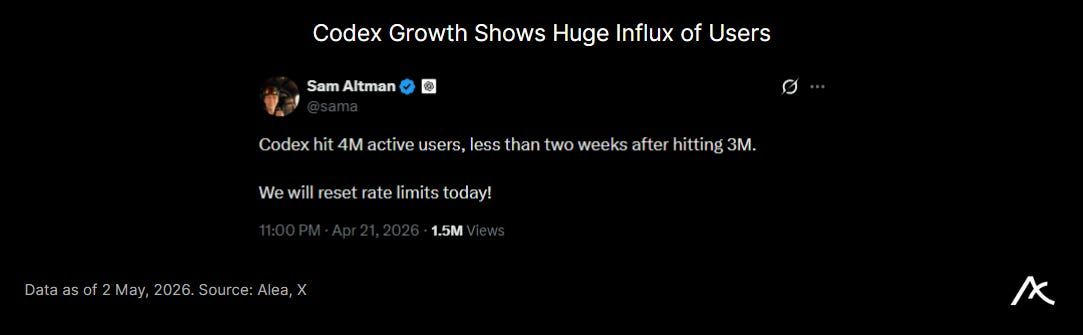
Missing 1B weekly users might as well be a timing issue, considering Codex only started taking off recently.
Signals Radar
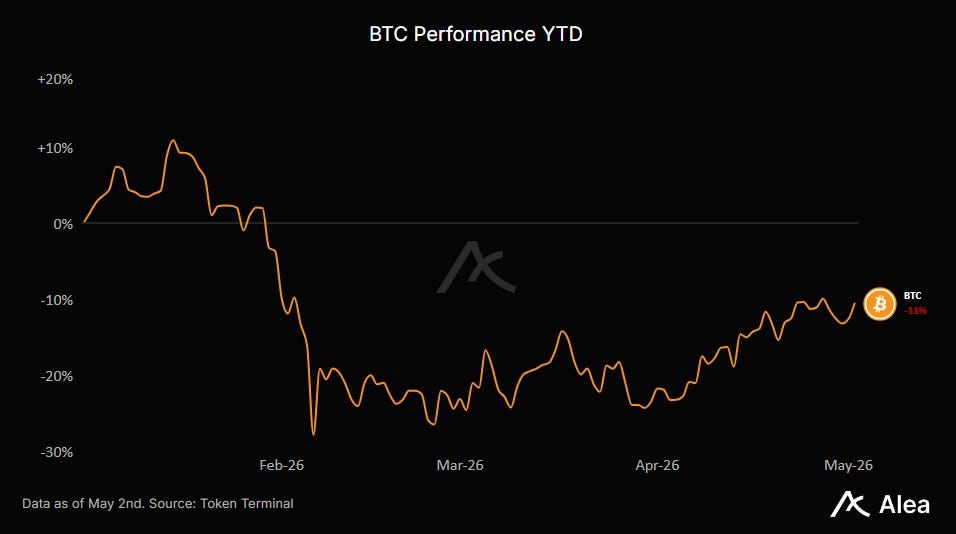
BTC — Trading around $76k, with BTC dominance near 58%. Market structure is tired but not dead. The problem is flows: U.S. spot BTC ETFs saw roughly $138M net outflows on April 29, extending a three-day outflow streak. It gets attractive if BTC reclaims $78k–$80k with ETF flows flipping positive, but below $72k–$73k, the market is telling you the dip bid is gone.
ETH — Five years since the 2021 bull market, same price. Five years of staking, L2 scale-out, restaking, stablecoins, RWAs, and institutional rails, and spot still round-tripped to the same zone. That is not “cheap” by itself; it is a verdict on supply, narrative fatigue, and weak marginal buyers.
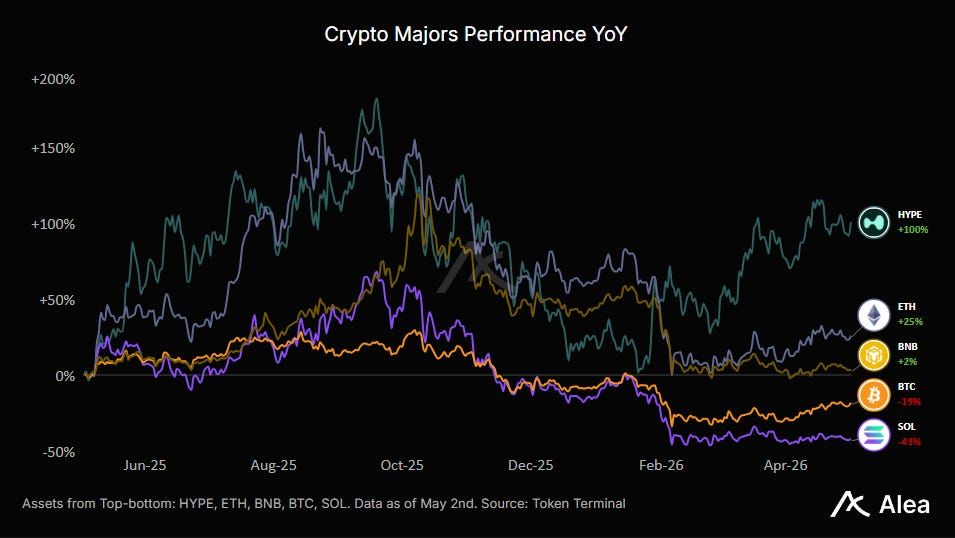
SOL — Around $83, stuck in the $82–$88 range and still far below the prior cycle high. The short-term catalyst is Solana Accelerate USA on May 5, 2026, with payments, DeFi, tokenization, and AI infrastructure on the agenda.
BNB — Holding a more solid structure than most majors but failing to reclaim the $640 area. The 35th quarterly burn on April 15 removed about 1.57M BNB, roughly $1B, and the Osaka/Mendel upgrade on April 28 added execution and gas-limit improvements. That supports the asset, but it does not force a bid unless price confirms. Buy strength above $640; stop below $600.
HYPE — Remains the revenue-allocation benchmark in liquid crypto. Price was down on the week but still one of the few large caps with real revenue and visible token-level accrual. The catalyst stack is actually quite heavy, including prediction markets with HIP-4 while HIP-3 keeps expanding the permissionless-perps surface across equities and commodities.
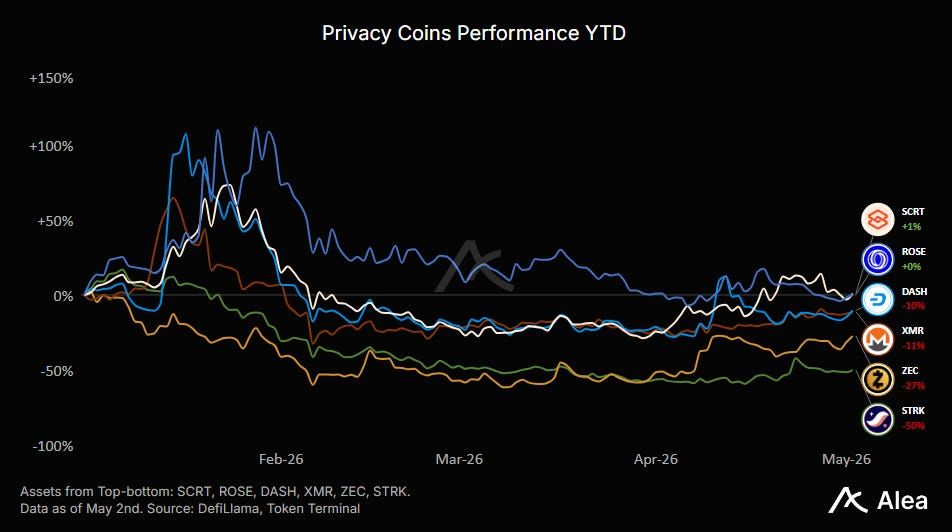
ZEC — Robinhood access expanded retail availability, and THORChain has started rolling out native ZEC swap support. This remains the privacy leader, not worth diluting with multiple illiquid beta names.
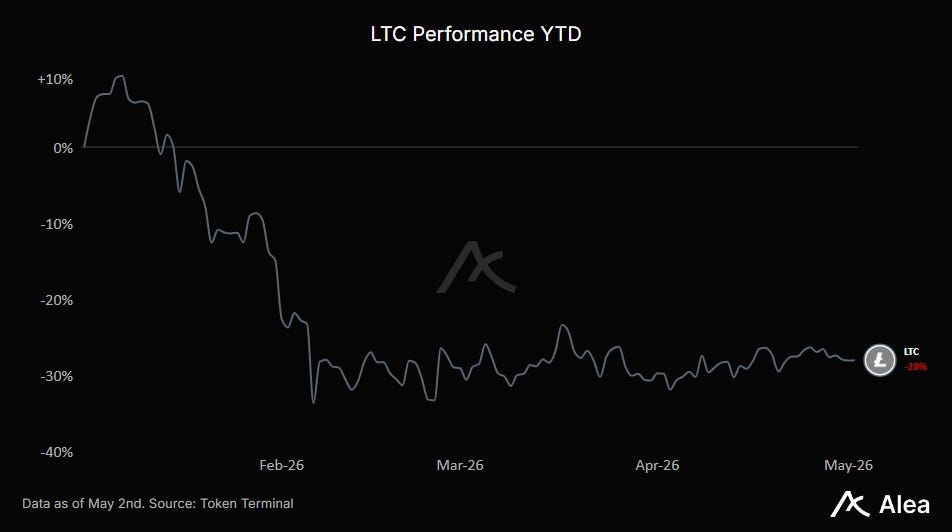
LTC — Last Sunday the chain suffered disruption tied to invalid MWEB transactions and non-updated mining nodes. This caused a 13-block reorg, reversed invalid transactions, disrupted major mining pools, and initially looked to some observers like a 51% attack. Litecoin’s team confirmed the zero day, but said that valid transactions were unaffected, the bug was patched, and the network was operating normally by 4:22 p.m. ET. The 13-block sequence took more than 3 hours, versus roughly 32 minutes under normal timing. NEAR Intents initially flagged about $600k of exposure, though settled losses may be lower.
AAVE — After governance, the balance-sheet got tested. Aave has revenue, brand, risk systems, and lender trust, but things are moving fast and nobody is exempt from protocol risk these days. In addition to the DeFi Recovery Fund coordinated bailout targeting $200M, Circle provided a defense bid, with Circle Ventures buying AAVE saying “strong DeFi infrastructure does not build itself.” The messaging feels like fattening a turkey that’s still on the Thanksgiving menu, as if money alone could solve the underlying root causes of DeFi’s security problems. That said, the market’s read is that Aave is too systemic to let wobble.
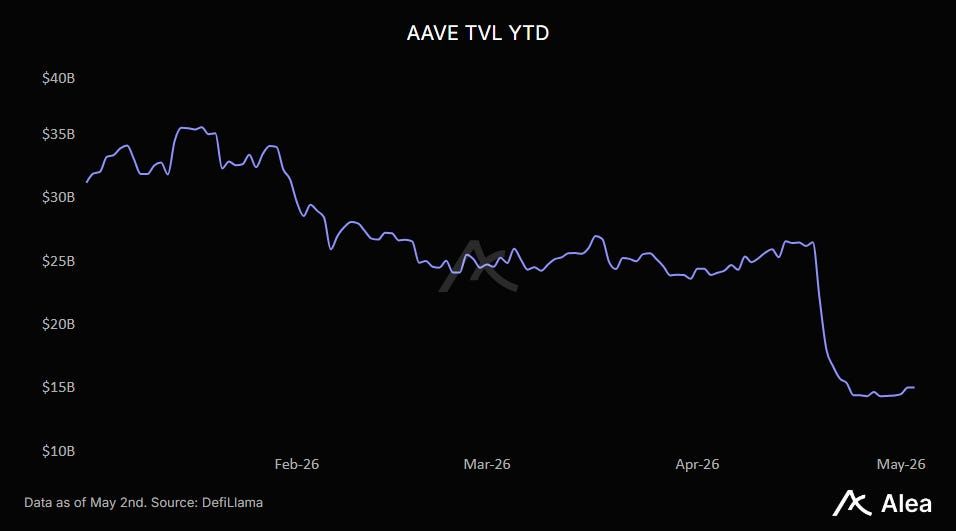
AAVE is also pausing its buyback program, which is the uncomfortable part now that the rsETH recovery needs treasury flexibility. Buybacks were paused effective Apr 19 and will stay paused until the rsETH situation resolves. This decision removes the exact mechanical bid that kept holders happy and that attracted marginal buyers looking for proof of revenue. AAVE is still a leader, but the trade is now governance/recovery first, buyback multiple second.
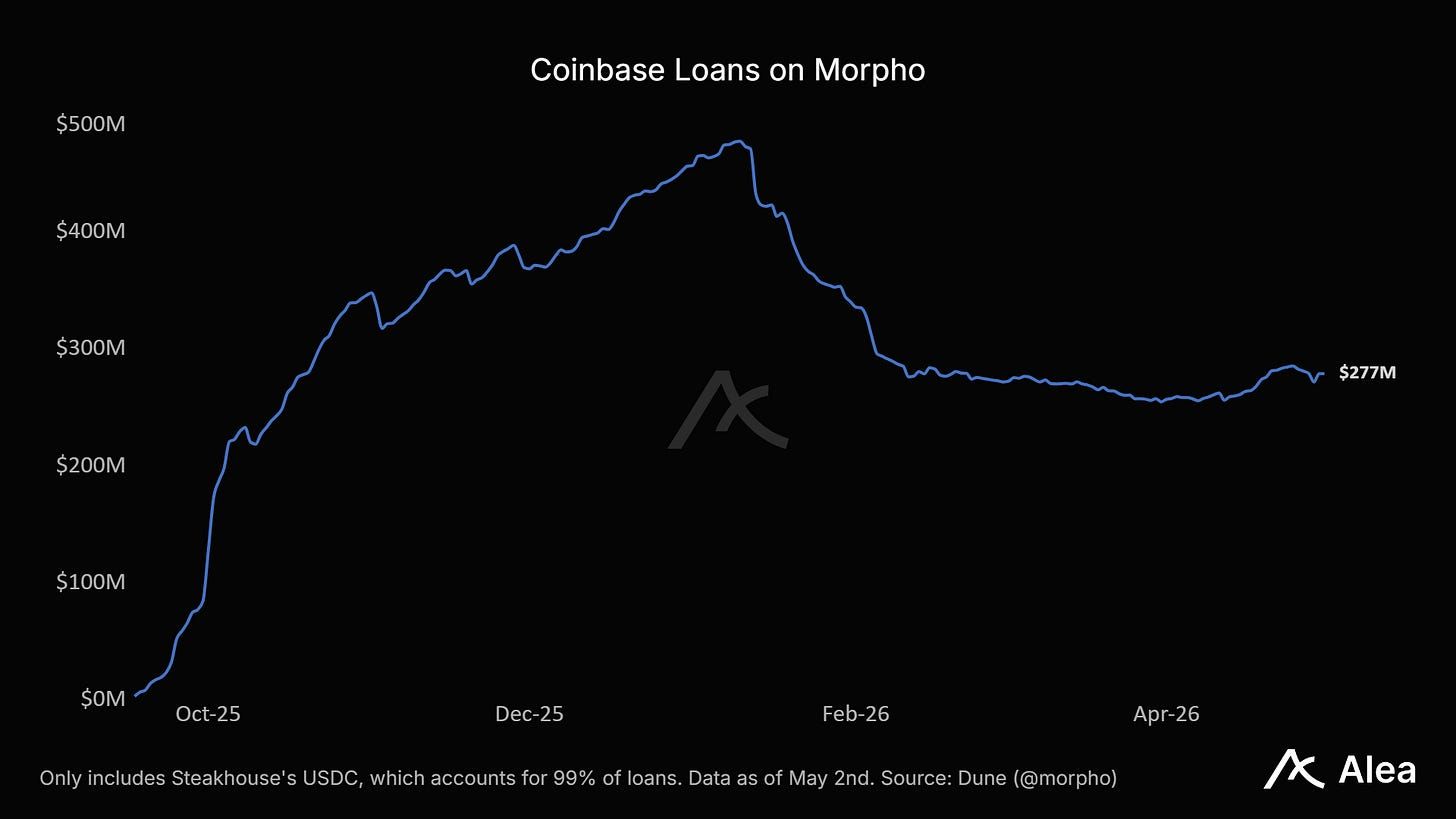
MORPHO — While Aave was busy stewarding the recovery of ~160k+ ETH, Morpho kept quietly compounding with Coinbase loan metrics doing most of the talking. This was the moment when Morpho could have run victory laps about isolated markets versus Aave’s pooled risk. But rather than hammer that line, they took the chance to showcase how an immutable protocol can still grow massively with a distribution winner. Coinbase has already originated more than $2.17B USDC through the Morpho-powered loan product and expanded the product to the UK, converting DeFi credit into something a normal user can understand: borrow USDC against crypto.
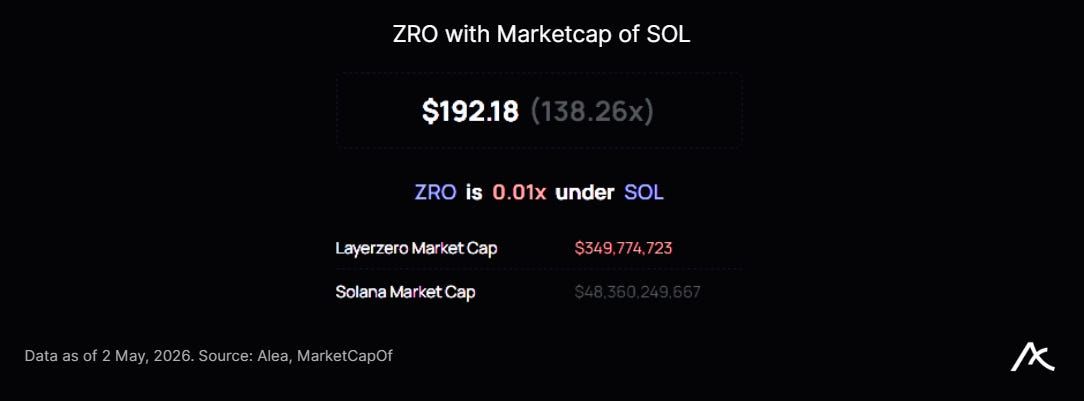
ZRO — Pending Zero’s mainnet launch, expected for Q3, ZRO remains the trust-index for crypto’s crosschain future. Some say that they will prioritize competing against top L1s like Solana as the crosschain vision takes the back seat. However, the current scenario is not something that can be easily side-stepped.
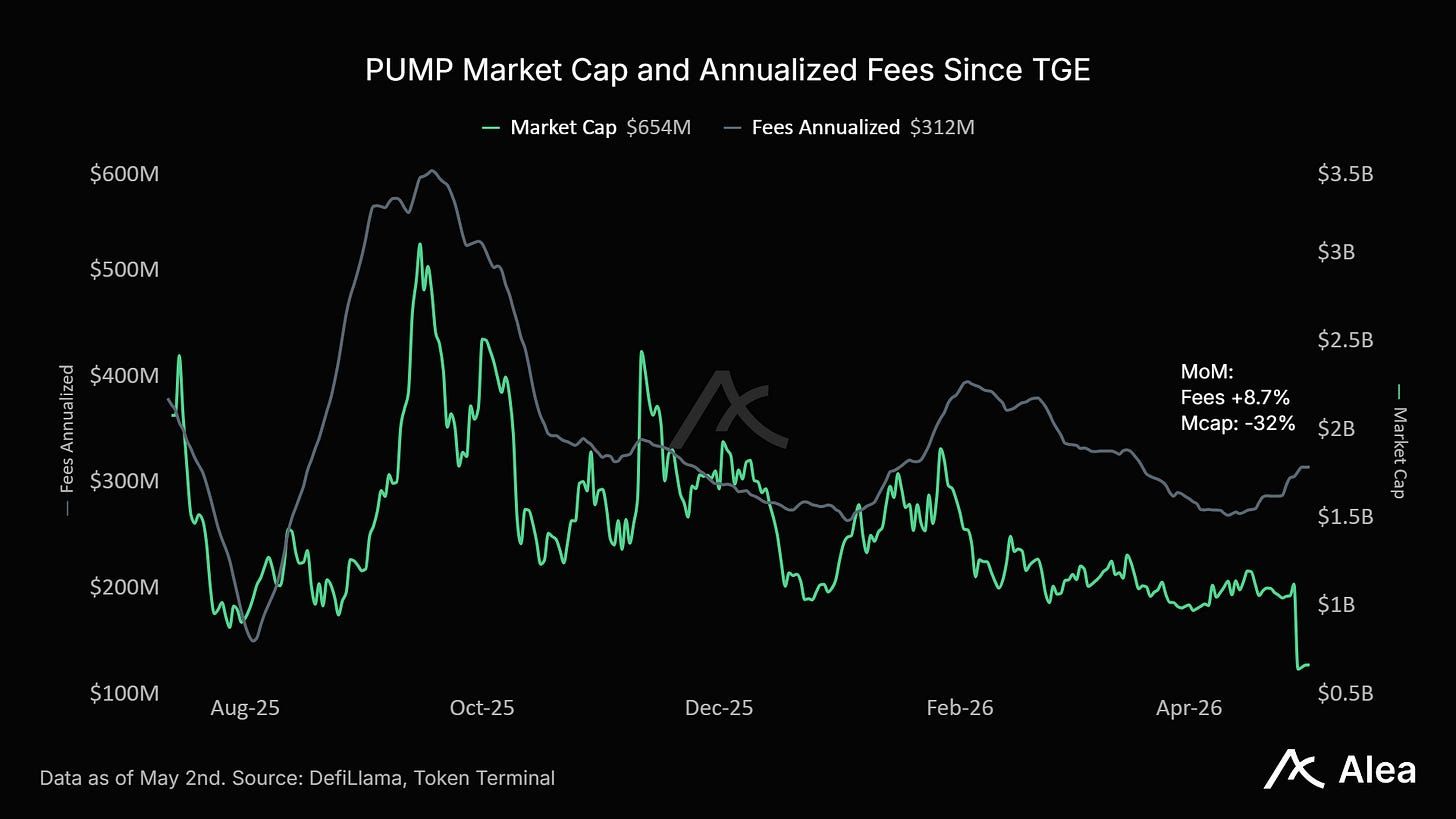
PUMP — Counterpoint to Hyperliquid, where fees are directly linked to buyback amounts, Pump has spent heavily on buybacks, yet the token still struggles as the market questions its durability. Buybacks cannot save a business if users, revenue, or product scope decay. This week they came out with an answer: burning all tokens they bought back (~36% of circulating supply), or ~$370M worth of purchases. They justify this capital destruction act under the argument of “gain trust with our community.” The prior 100% revenue buyback model is now replaced by a one-year 50% revenue buyback-and-burn program. The other 50% stays inside the business for operations, hiring, marketing, acquisitions, and new products. Pump now trades around 2.3x market-cap / annualized revenue or 5.5x FDV / annualized revenue. A 50% revenue buyback policy implies roughly 22% annualized buyback yield on market cap and 9% on FDV, before revenue decay, price impact, unlocks, or execution risk.
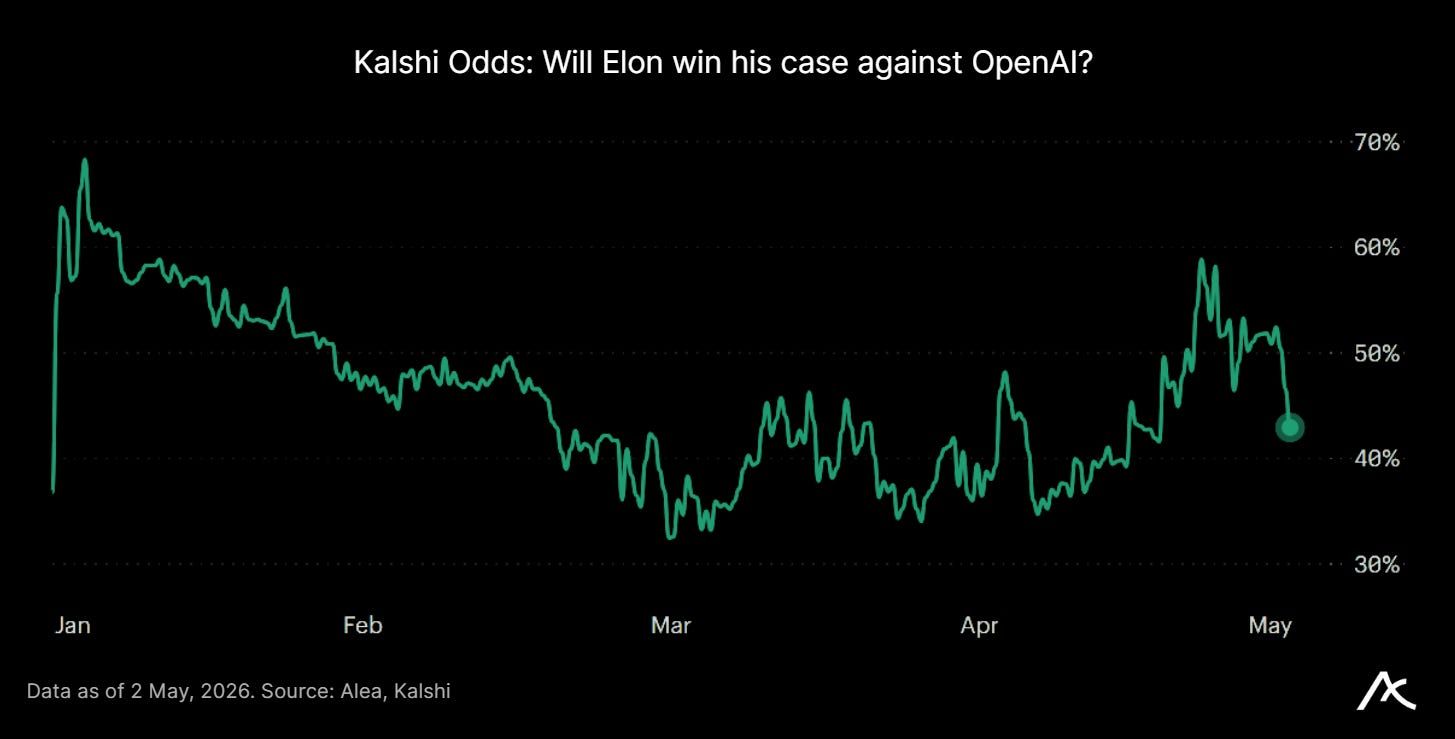
WLD — The Musk-Altman trial opened in Oakland on April 28 after jury selection on April 27, with Musk challenging OpenAI’s pivot from nonprofit mission to profit-seeking structure.
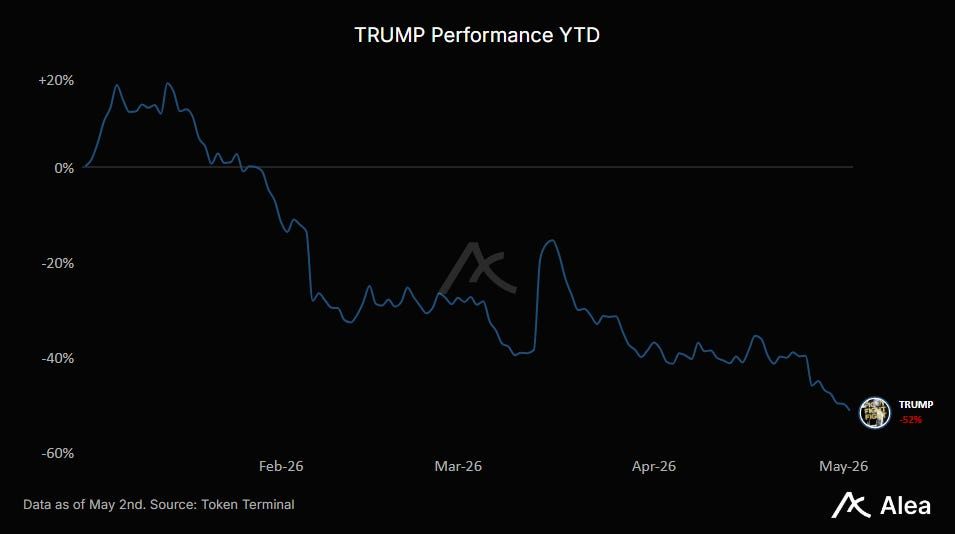
TRUMP — Volatility input to kick the week off as a gunman attacked the security perimeter outside the White House Correspondents’ Dinner at the Washington Hilton. Trump was evacuated unharmed; the suspect was taken into custody; a Secret Service agent was struck but protected by body armor. This came right after the April 25 Trump crypto luncheon at Mar-a-Lago for top TRUMP memecoin holders.
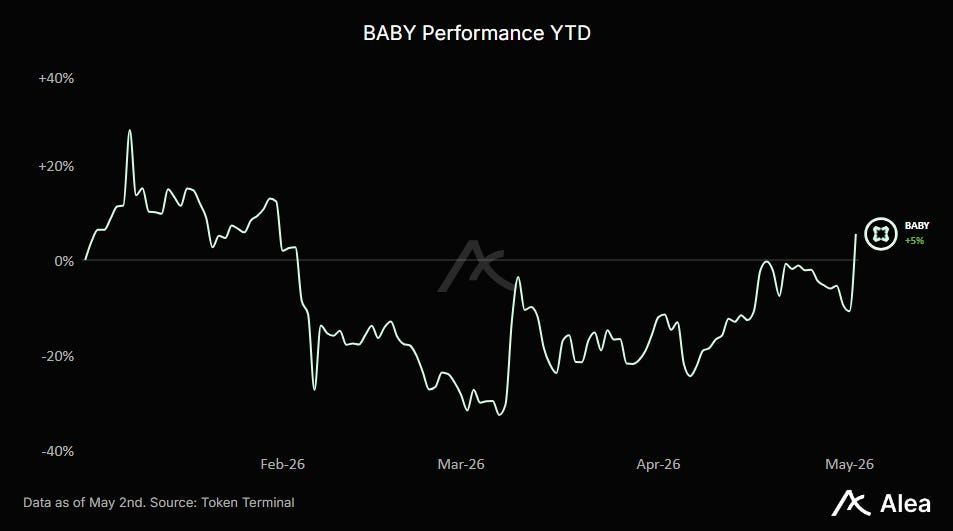
BABY — Babylon changed its lockup schedule: the large April 10 unlock was removed, and the first unlock now starts May 10, released monthly at 1/36th through April 2029.
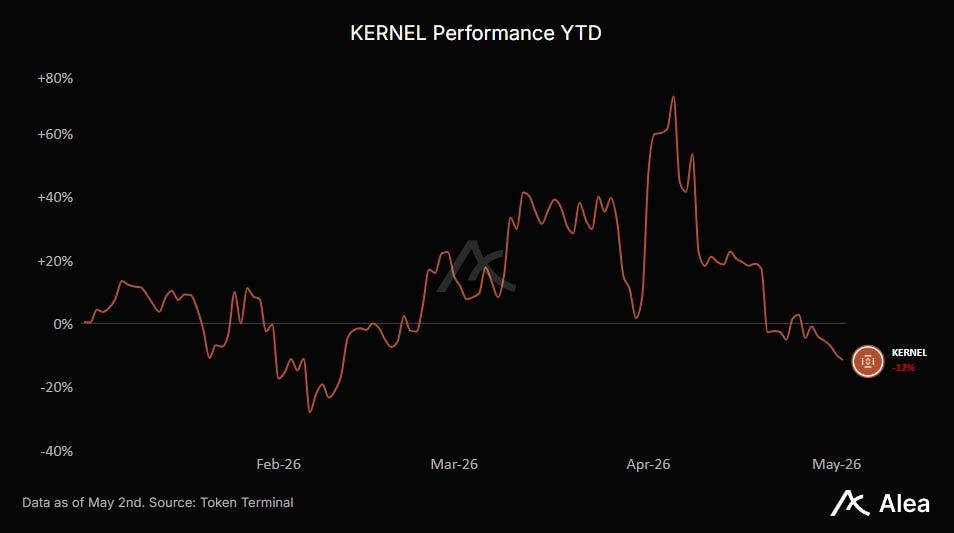
KERNEL — From open-ended contagion risk to a recovery execution trade. DeFi United is now the backstop, with major lines from Arbitrum, Consensys/Joe Lubin, Mantle, Aave DAO, Stani, EtherFi, Lido, Kelp, and others. The plan is to convert committed ETH into rsETH in tranches, send it back into the affected lockbox, restore backing, then unwind attacker-linked lending positions in a controlled sequence. For KERNEL, this is relief-bid material, but not necessarily the green light. Execution removes existential risk and can re-rate the token from “protocol failure” to “coordinated DeFi rescue”; delays around governance votes, legal agreements, bridge reopening, or liquidation sequencing keep the overhang alive.
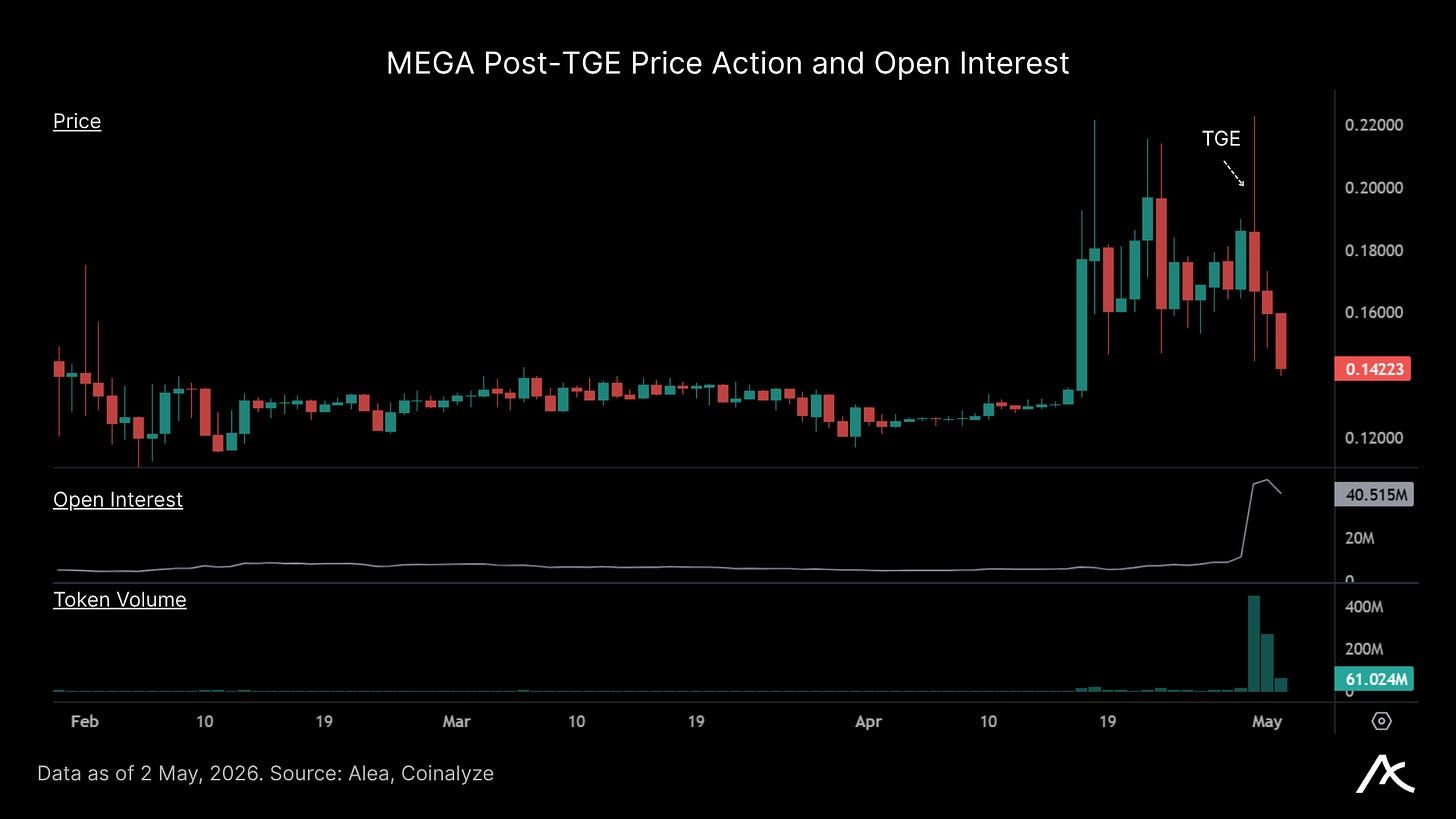
MEGA — TGE went live on Apr 30 after MegaETH hit the 10/10 MegaMafia apps KPI on Apr 23. To recap, the thesis is a real-time Ethereum execution environment (sub-10ms blocks, 100k+ TPS, Ethereum settlement) with a token model trying to fight the low-float/high-FDV curse: 53% KPI rewards, USDm/Ethena reserve rewards used for MEGA buybacks, and planned proximity/sequencer markets that monetize latency rather than taxing users through higher fees. What matters next: USDm supply, bridge TVL, Kumbaya/DEX depth, Terminal points activity, and app KPI cadence.
NVDA — Adding $4.9T in market cap since 2022, Nvidia stock celebrated a new all-time-high worth $5.2T. This degree of index concentration presents both a market structure and flows problem. As long as AI capex keeps clearing the next check, global equity indices can continue grinding higher. The trend is up, but the index is leaning on one name with less margin for doubt.
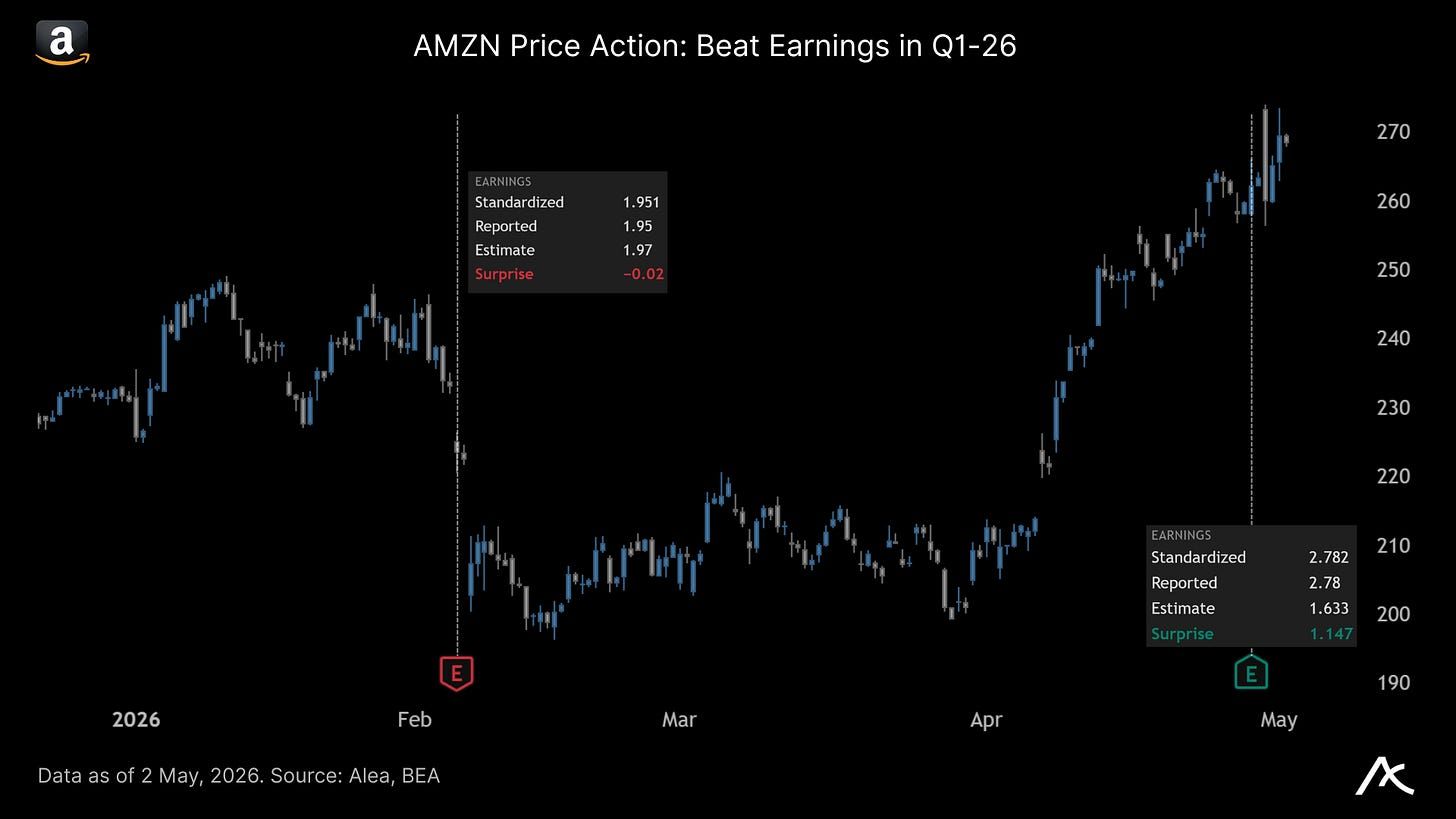
AMZN — AWS finally re-accelerated: +28% to $37.6B, fastest growth in 15 quarters, with Q2 sales guided to $194–199B and ads still compounding at +24%. The market likes this because the AI spend has revenue attached, but the flaw is that FCF collapsed to $1.2B TTM and Q1 EPS included a $16.8B Anthropic gain.
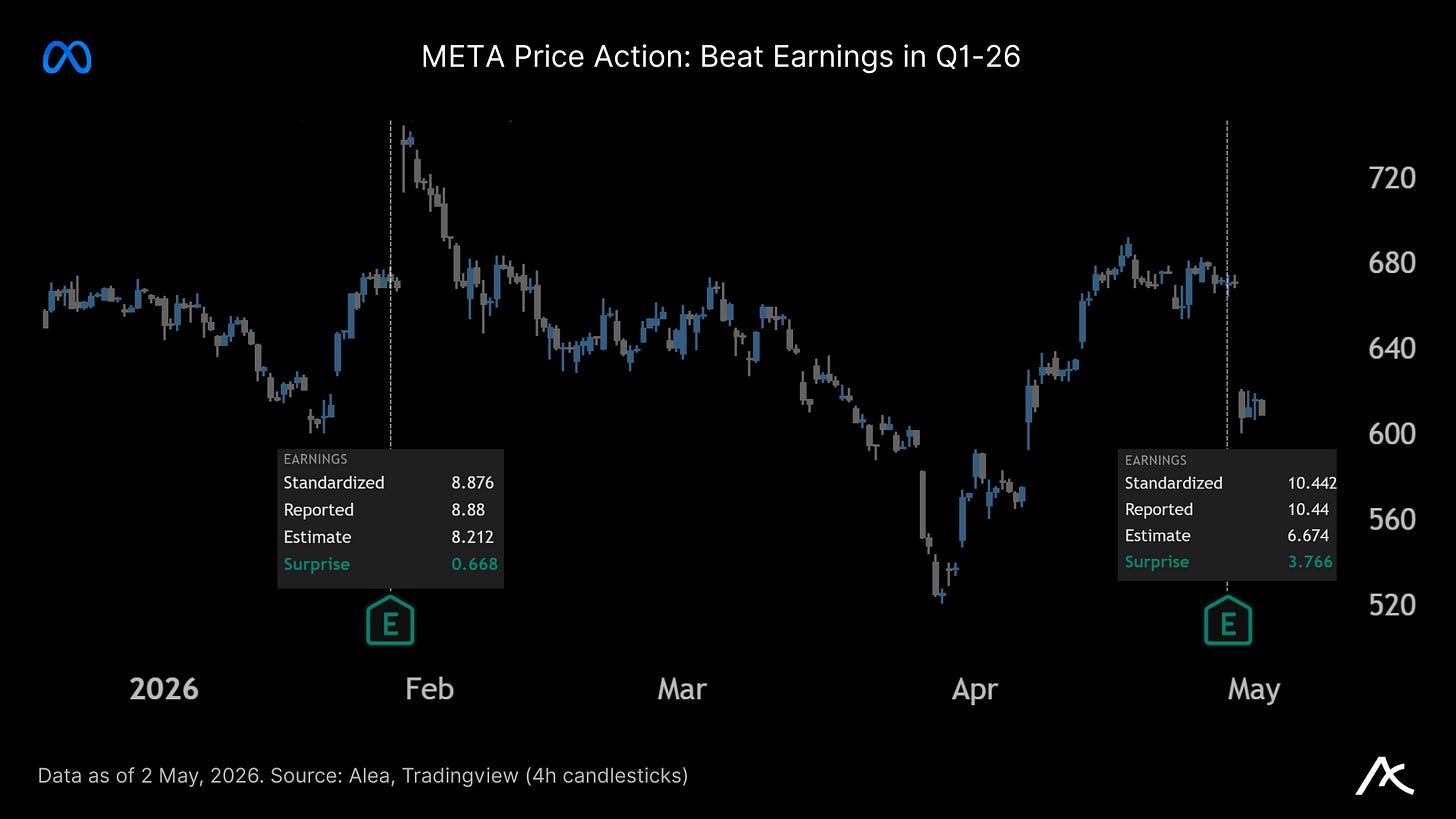
META — The market refused to buy into the story despite a strong headline. Revenue +33% to $56.31B, operating margin held at 41%, ad impressions +19%, ad pricing +12%, but the market saw the capex raise to $125–145B, first quarterly DAP decline, youth-safety litigation risk, and an EPS print helped by an $8.03B tax benefit. This was interpreted as capex without enough incremental proof. Thursday’s session saw the stock falling >10%, erasing ~$170B in market cap (biggest daily decline since October 2025).
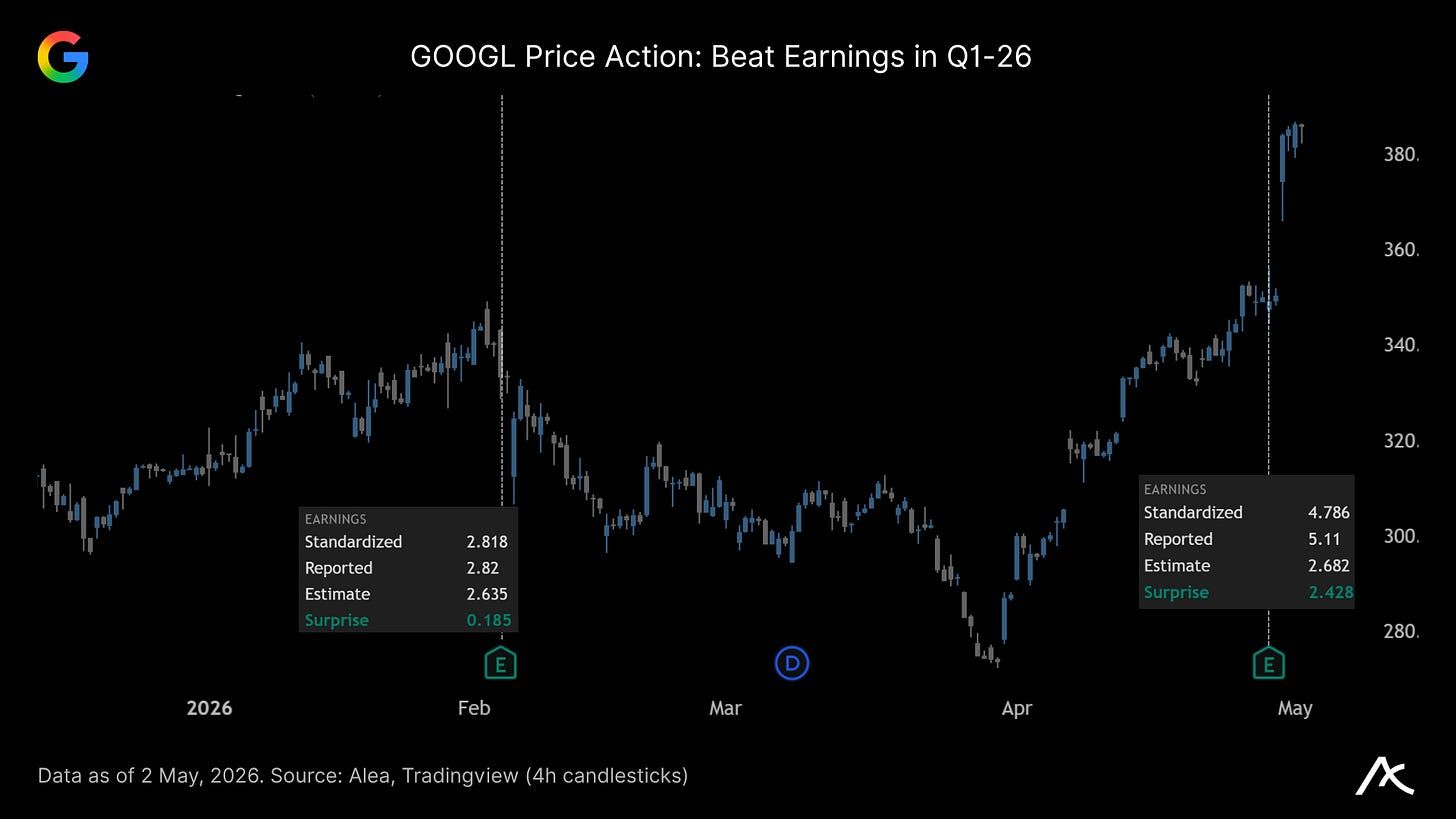
GOOGL — Google showed actual monetization in the midst of “AI bubble” talks. Revenue +22% to $109.9B, Cloud +63% to $20.0B, and 36.1% operating margin. EPS was flattered by $36.9B equity-security gains and buybacks were zero. Still enough for many to justify holding GOOGL as the current AI winner while we wait for Anthropic and OpenAI to IPO.
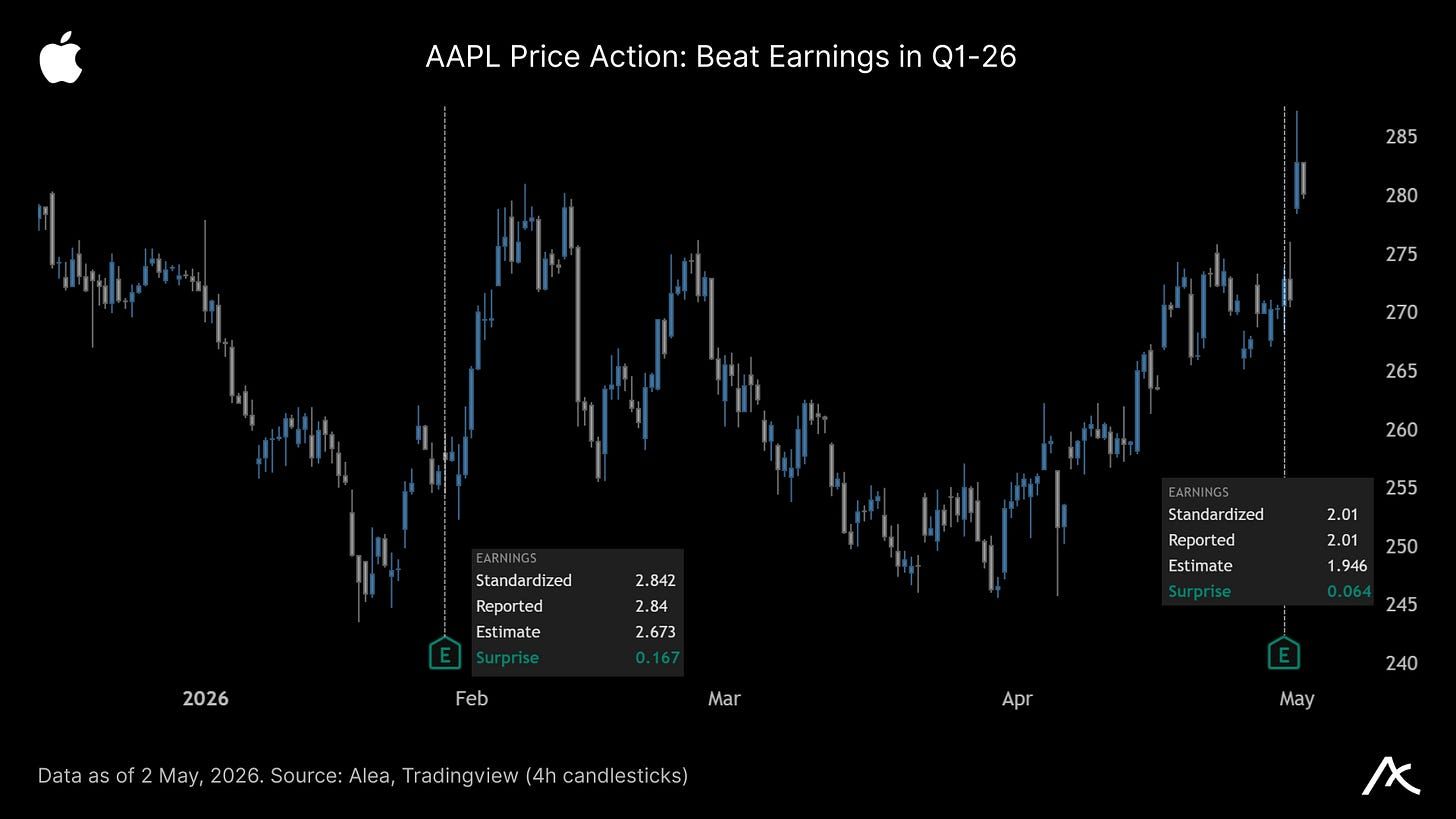
AAPL — Mega-cap defensive beat: fiscal Q2 revenue $111.2B, +17% YoY; EPS $2.01, +22%; operating cash flow above $28B; Services at a new all-time high; $100B added buyback; dividend up 4% to $0.27. The market gets an iPhone 17 cycle, a capital-return floor, and a CEO transition narrative with John Ternus taking over September 1 while Cook moves to executive chairman. The flaw is valuation and AI: AAPL trades around $271, ~$4.0T market cap, ~34x earnings. WWDC is now in the spotlight on June 8–12; investors need to see Siri/AI progress, not another “services and buybacks” victory lap.
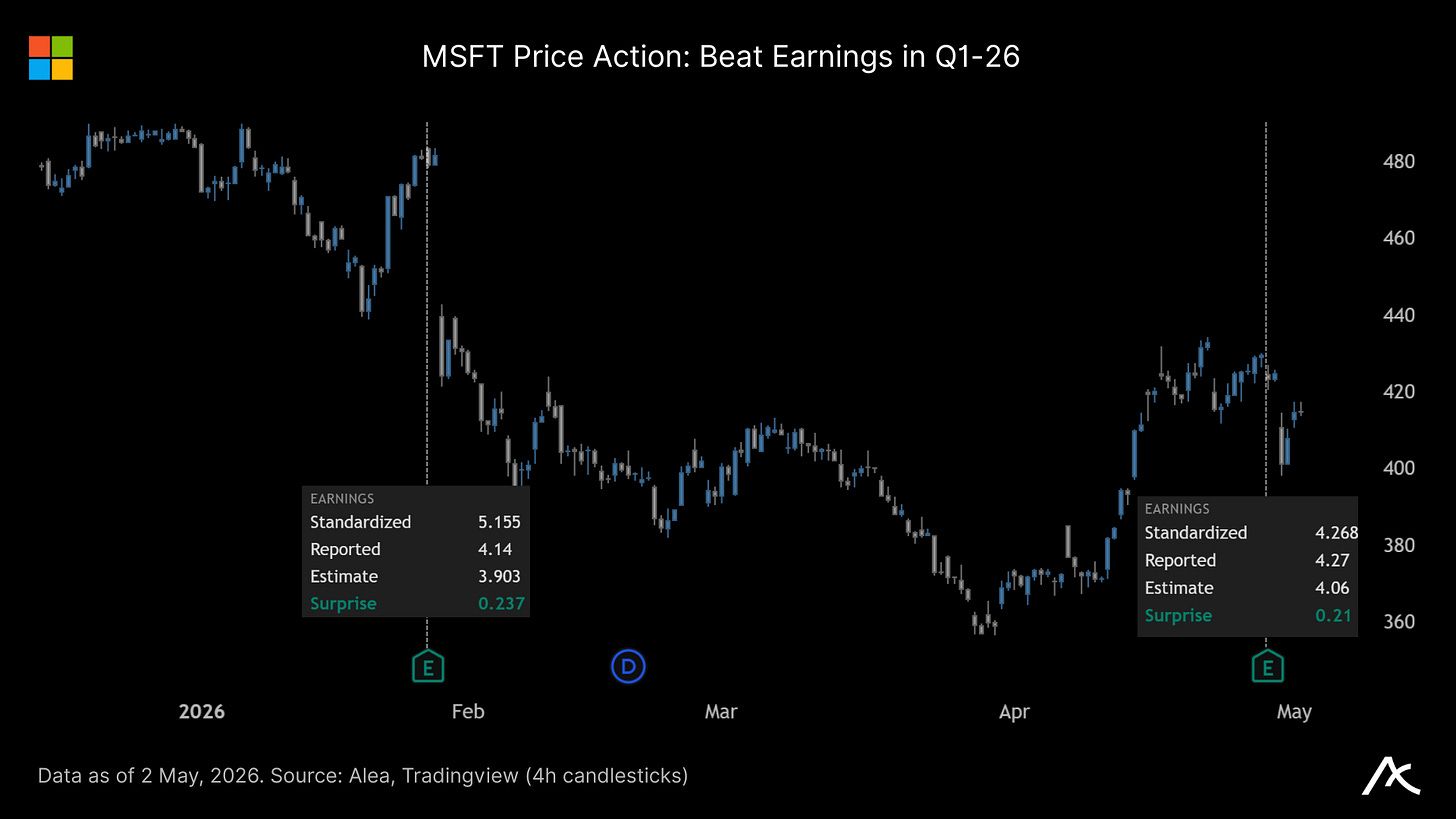
MSFT — The stock printed a -5% candle on the renewal of its partnership with OpenAI on Monday. It then revealed strong numbers on Wednesday’s earnings, but still had a messy reaction. Revenue +18% to $82.9B, EPS $4.27, Azure +40%, AI revenue run-rate $37B, but the market didn’t love a $190B 2026 capex plan and Google Cloud’s +63% made Azure look less dominant.
Under the new agreement Microsoft stays as the primary cloud partner while OpenAI products ship first on Azure where Azure can support them. That allows Microsoft to keep OpenAI model/product IP rights through 2032. The change is exclusivity: the license is now non-exclusive, OpenAI can serve products across any cloud, Microsoft stops paying OpenAI revenue share, and OpenAI’s payments to Microsoft continue through 2030 under a cap. MSFT therefore loses the exclusivity premium, but keeps distribution, IP access, and shareholder upside.
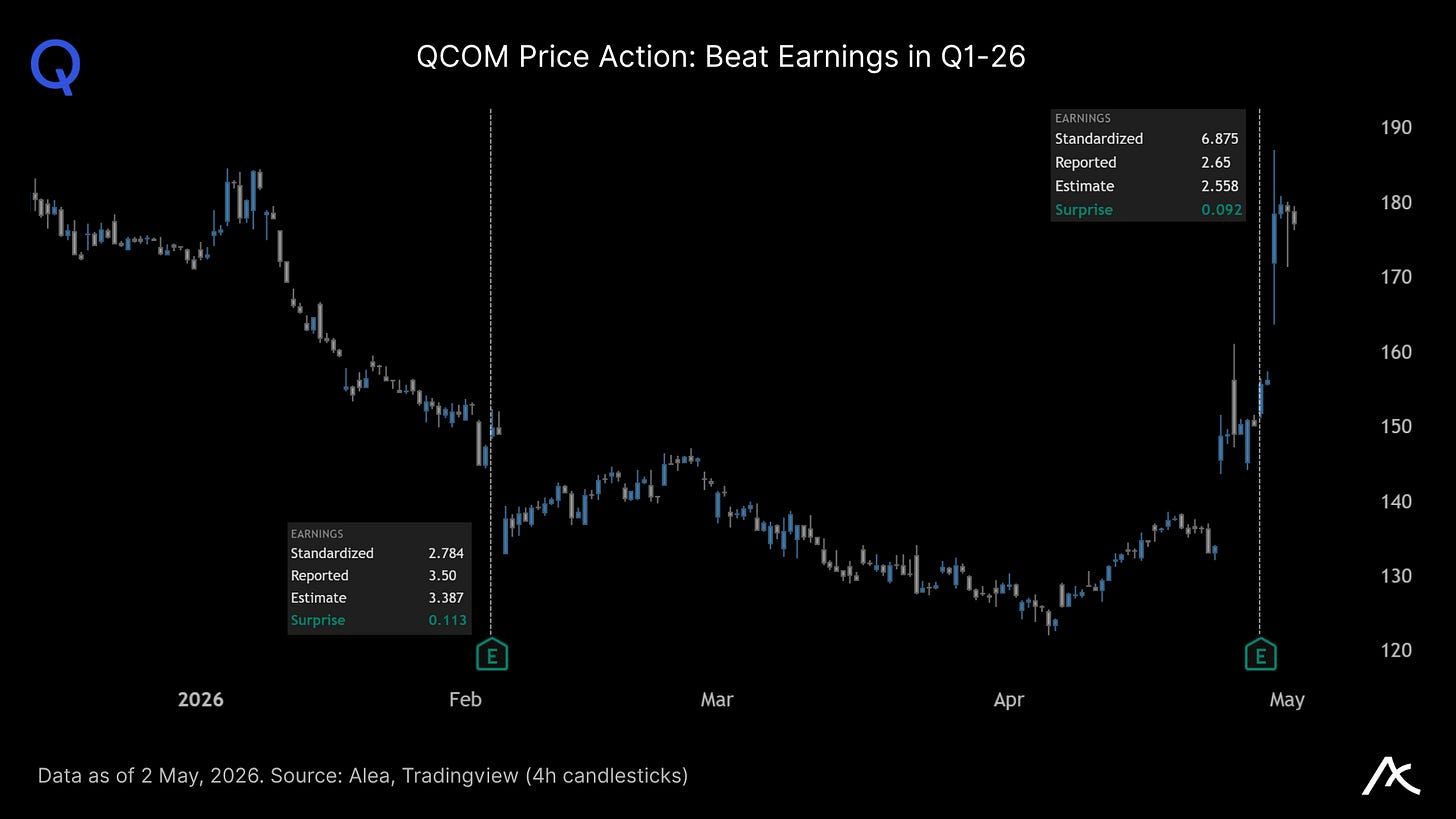
QCOM — Best earnings reaction outside the Mag-7. Core numbers were not the whole story: revenue $10.6B, non-GAAP EPS $2.65, Q3 guide soft at $9.2–10.0B and $2.10–2.30 EPS, but the stock ripped because management teased custom data-center silicon shipments to a major hyperscaler later this year and called a China handset bottom. June 24 Investor Day is the next catalyst.
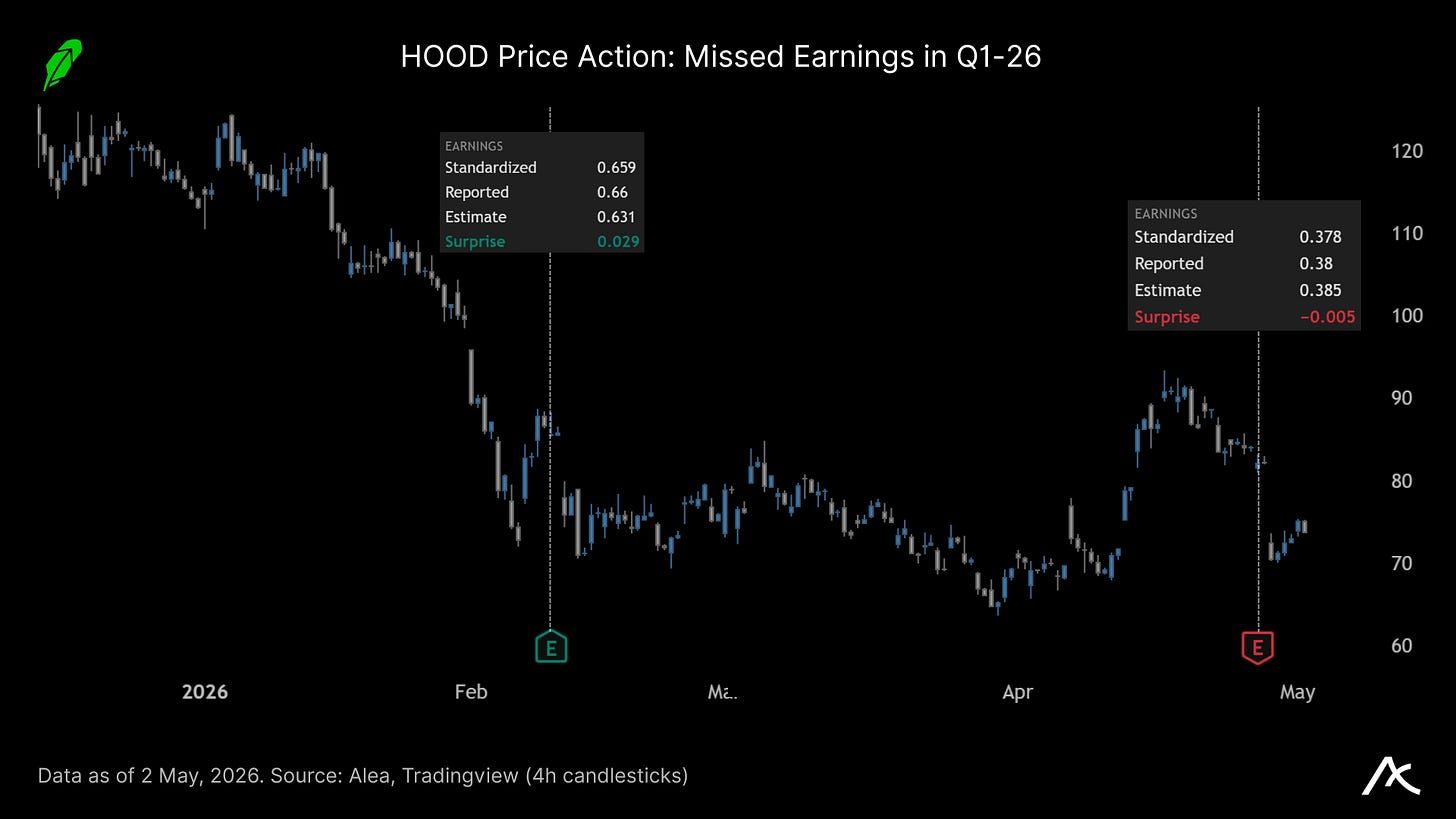
HOOD — Kicked off the week being sold off because of weak numbers. Headline growth wasn’t enough to satisfy expectations. Revenue +15% YoY to $1.07B, EPS $0.38, net deposits $17.7B, platform assets $307B, Gold subs 4.3M; solid. Flaw: crypto revenue fell 47% YoY to $134M, operating expenses rose 18%, and the market still sees HOOD as trading-cycle beta with too much dependence on risk appetite. Event contracts/other transaction revenue up 320% to $147M and the $1.5B buyback keep optimism alive, but short-term you would like to see it reclaim the post-print breakdown.
Conclusion
This is a market where risk has to pay upfront. Macro is digesting oil above $100, sticky inflation, and a Fed that cannot cut into a fuel shock without losing credibility. Crypto is no longer rewarded for “value accrual”; capital wants hard evidence in the form of product-market-fit + revenue, buybacks that do not starve the business, and liquidity that survives stress.