Onchain lending has become almost an institutional market. Lenders processed hundreds of billions in volume through 2025, and Aave remains the category leader. By early 2026 the protocol reported $34-36 billion in TVL (51.2% of DeFi lending market) and annualized revenue around $130 million. This scale dwarfs rivals and underscores how deeply Aave’s liquidity model has impacted DeFi.
A recent change however redirected swap routing economics away from the DAO treasury and toward Aave Labs, triggering accusations of “stealth privatization” and exposing a weakness in its governance regarding who controls the revenue rails when the brand and interface are not fully DAO-owned. Estimates circulating publicly put the amount at ~$10M/year going to the Labs’ wallet (not large for Aave, but large enough to matter as a precedent).
In this edition, we’ll look into the Labs vs DAO value capture split, why interface fees are a governance stress test, and potentially what to monitor as the next vote approaches.

Introduction to Aave
Launched in 2017, Aave is a lending protocol that allows users to deposit crypto assets and borrow against them. Depositors receive aTokens which are interest‑bearing representations of their collateral. Borrowers pay variable interest rates and must maintain collateral ratios to avoid liquidation.
Aave generates revenue from net interest spreads, with a portion of fees paid to liquidity providers and the remainder accruing to the DAO. It operates across multiple chains and supports dozens of assets.

The protocol’s architecture has evolved through multiple versions. V3, live since 2022, introduced portal bridges for cross‑chain liquidity and risk isolation for exotic assets. V4 is slated for mainnet in 2026, which sees a switch from rebasing aTokens to ERC4626 share accounting, which improves integrations and tax handling. This change means user balances remain constant while yield is reflected in a rising share price, making deposits easier to track.
V4 also introduces a modular hub & spoke model that can plug in modular borrowing logic.
Governance, Ownership and Aligning Incentives
Aave recently announced a change in its frontend swap provider from Paraswap to CoWSwap on 4 Dec 2025, with swap fees that previously accrued to the DAO, now flowing to an Aave Labs wallet, estimated at $200k/week (working out to ~$10M annualized). All this happened discretely
This situation created a widespread governance conflict (more on that later) which illustrates a deeper question facing DeFi: who owns the value generated by protocols?
In Aave’s case, the DAO controls onchain parameters and the treasury (generally anything token-related), while Aave Labs controls the frontend interface, domains and intellectual property.
For years this dual structure worked because both parties were aligned.
The CoWSwap saga shattered that assumption, revealing that private entities can monetize interfaces separate from the DAO and leaving token holders uncertain whether they truly own anything. This is not unique to Aave. Protocols like Maker, dYdX and Lido each had their battles between foundation‑controlled products and DAO governance.
The drama caused a selloff of ~25% due to governance uncertainty as capital allocators value enforceable rights to revenue. Conversely, the bounce after Stani’s revenue‑sharing statement suggests that investors will pay up for clarity. AAVE’s drawdown may thus be a temporary governance premium rather than a structural decline.
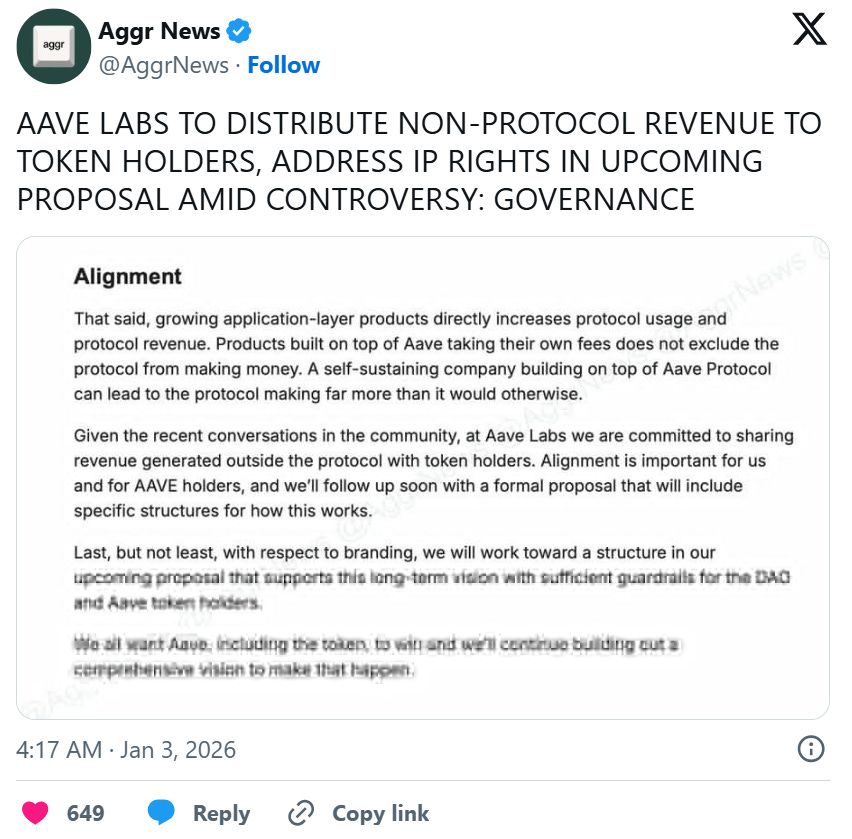
Core Update: Governance Crisis and the Path Forward
Delegates argued this revenue stream belonged to token holders and should be controlled by the DAO. A proposal to transfer brand assets (domains, IP, social handles) to a DAO‑controlled entity went to a snapshot vote over the holidays and failed, partly due to an abstain campaign protesting the rushed timing.
Market reaction: During the dispute AAVE fell ~25%, even though TVL and fee generation remained intact. Investors were pricing the risk that token holders might never capture interface revenue. After Stani publicly committed to sharing off‑protocol revenue with token holders, the token jumped ~10%. The market is clearly sensitive to governance alignment.
V4 & Mainnet consolidation: The V4 roadmap emphasizes a shift to ERC‑4626 accounting and a pullback from unprofitable deployments. For allocators this reduces operational complexity and should improve integration with institutional partners but may reduce optionality for yield farming across chains.
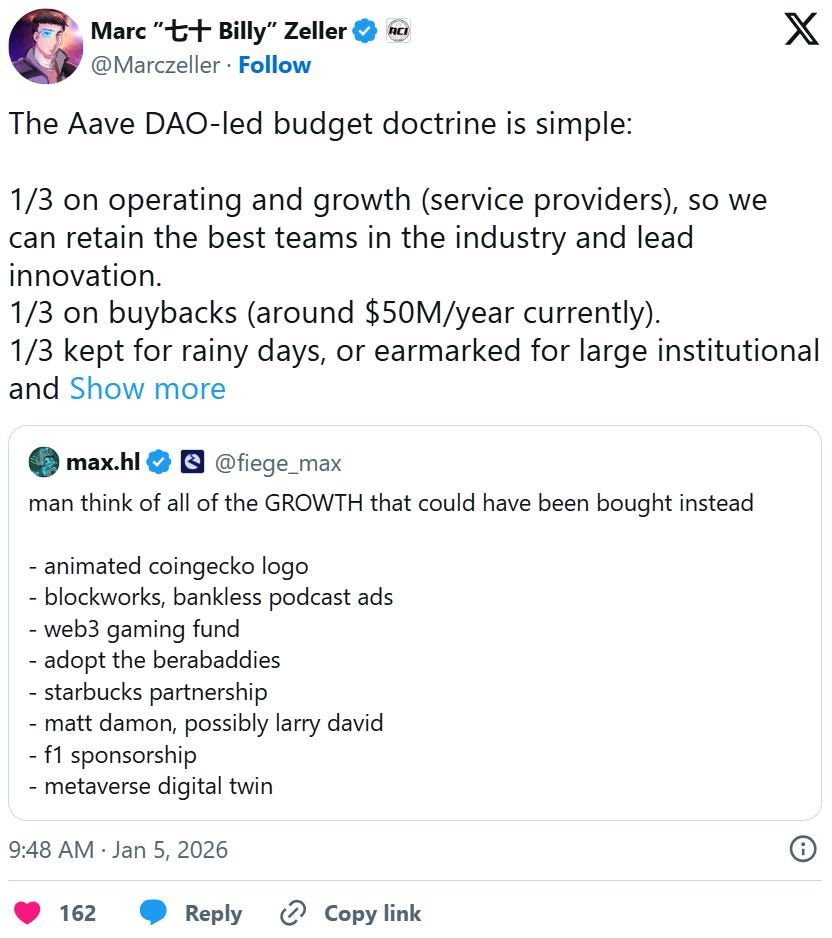
ACI’s Marc Zeller estimates annual net protocol revenue at ~$130 million, but notes that 80-95% of gross revenue goes to liquidity providers. Closing thin deployments and launching new products like Aave’s GHO stablecoin may improve net margins.